


Databricks-Certified-Data-Engineer-Professional Dumps Free Test Engine Player Verified Updated [Oct 03, 2025]
Q&As with Explanations Verified & Correct Answers
NEW QUESTION # 35
The data architect has mandated that all tables in the Lakehouse should be configured as external (also known as "unmanaged") Delta Lake tables.
Which approach will ensure that this requirement is met?
- A. When a database is being created, make sure that the LOCATION keyword is used.
- B. When configuring an external data warehouse for all table storage, leverage Databricks for all ELT.
- C. When tables are created, make sure that the EXTERNAL keyword is used in the CREATE TABLE statement.
- D. When the workspace is being configured, make sure that external cloud object storage has been mounted.
- E. When data is saved to a table, make sure that a full file path is specified alongside the Delta format.
Answer: C
Explanation:
Get Latest & Actual Certified-Data-Engineer-Professional Exam's Question and Answers from To create an external or unmanaged Delta Lake table, you need to use the EXTERNAL keyword in the CREATE TABLE statement. This indicates that the table is not managed by the catalog and the data files are not deleted when the table is dropped. You also need to provide a LOCATION clause to specify the path where the data files are stored.
For example:
CREATE EXTERNAL TABLE events ( date DATE, eventId STRING, eventType STRING, data STRING) USING DELTA LOCATION `/mnt/delta/events'; This creates an external Delta Lake table named events that references the data files in the
`/mnt/delta/events' path. If you drop this table, the data files will remain intact and you can recreate the table with the same statement.
NEW QUESTION # 36
A data architect has heard about lake's built-in versioning and time travel capabilities. For auditing purposes they have a requirement to maintain a full of all valid street addresses as they appear in the customers table.
The architect is interested in implementing a Type 1 table, overwriting existing records with new values and relying on Delta Lake time travel to support long-term auditing. A data engineer on the project feels that a Type 2 table will provide better performance and scalability. Which piece of Get Latest & Actual Certified-Data-Engineer-Professional Exam's Question and Answers from information is critical to this decision?
- A. Delta Lake only supports Type 0 tables; once records are inserted to a Delta Lake table, they cannot be modified.
- B. Data corruption can occur if a query fails in a partially completed state because Type 2 tables requires setting multiple fields in a single update.
- C. Shallow clones can be combined with Type 1 tables to accelerate historic queries for long-term versioning.
- D. Delta Lake time travel does not scale well in cost or latency to provide a long-term versioning solution.
- E. Delta Lake time travel cannot be used to query previous versions of these tables because Type 1 changes modify data files in place.
Answer: D
Explanation:
Delta Lake's time travel feature allows users to access previous versions of a table, providing a powerful tool for auditing and versioning. However, using time travel as a long-term versioning solution for auditing purposes can be less optimal in terms of cost and performance, especially as the volume of data and the number of versions grow. For maintaining a full history of valid street addresses as they appear in a customers table, using a Type 2 table (where each update creates a new record with versioning) might provide better scalability and performance by avoiding the overhead associated with accessing older versions of a large table. While Type 1 tables, where existing records are overwritten with new values, seem simpler and can leverage time travel for auditing, the critical piece of information is that time travel might not scale well in cost or latency for long-term versioning needs, making a Type 2 approach more viable for performance and scalability.
NEW QUESTION # 37
The data governance team is reviewing user for deleting records for compliance with GDPR. The following logic has been implemented to propagate deleted requests from the user_lookup table to the user aggregate table.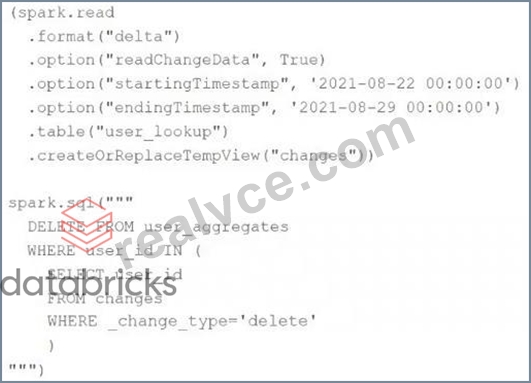
Assuming that user_id is a unique identifying key and that all users have requested deletion have been removed from the user_lookup table, which statement describes whether successfully executing the above logic guarantees that the records to be deleted from the user_aggregates table are no longer accessible and why?
- A. No; the Delta Lake DELETE command only provides ACID guarantees when combined with the MERGE INTO command
- B. Yes; Delta Lake ACID guarantees provide assurance that the DELETE command successed fully and permanently purged these records.
- C. Yes; the change data feed uses foreign keys to ensure delete consistency throughout the Lakehouse.
- D. No; the change data feed only tracks inserts and updates not deleted records.
- E. No; files containing deleted records may still be accessible with time travel until a BACUM command is used to remove invalidated data files.
Answer: E
Explanation:
Get Latest & Actual Certified-Data-Engineer-Professional Exam's Question and Answers from Explanation:
The DELETE operation in Delta Lake is ACID compliant, which means that once the operation is successful, the records are logically removed from the table. However, the underlying files that contained these records may still exist and be accessible via time travel to older versions of the table. To ensure that these records are physically removed and compliance with GDPR is maintained, a VACUUM command should be used to clean up these data files after a certain retention period. The VACUUM command will remove the files from the storage layer, and after this, the records will no longer be accessible.
NEW QUESTION # 38
Which of the following technologies can be used to identify key areas of text when parsing Spark Driver log4j output?
- A. Scala Datasets
- B. pyspsark.ml.feature
- C. Julia
- D. C++
- E. Regex
Answer: E
Explanation:
Regex, or regular expressions, are a powerful way of matching patterns in text. They can be used Get Latest & Actual Certified-Data-Engineer-Professional Exam's Question and Answers from to identify key areas of text when parsing Spark Driver log4j output, such as the log level, the timestamp, the thread name, the class name, the method name, and the message. Regex can be applied in various languages and frameworks, such as Scala, Python, Java, Spark SQL, and Databricks notebooks.
NEW QUESTION # 39
A data engineer, User A, has promoted a new pipeline to production by using the REST API to programmatically create several jobs. A DevOps engineer, User B, has configured an external orchestration tool to trigger job runs through the REST API. Both users authorized the REST API calls using their personal access tokens.
Which statement describes the contents of the workspace audit logs concerning these events?
- A. Because User A created the jobs, their identity will be associated with both the job creation Get Latest & Actual Certified-Data-Engineer-Professional Exam's Question and Answers from events and the job run events.
- B. Because the REST API was used for job creation and triggering runs, a Service Principal will be automatically used to identity these events.
- C. Because the REST API was used for job creation and triggering runs, user identity will not be captured in the audit logs.
- D. Because User B last configured the jobs, their identity will be associated with both the job creation events and the job run events.
- E. Because these events are managed separately, User A will have their identity associated with the job creation events and User B will have their identity associated with the job run events.
Answer: E
Explanation:
The events are that a data engineer, User A, has promoted a new pipeline to production by using the REST API to programmatically create several jobs, and a DevOps engineer, User B, has configured an external orchestration tool to trigger job runs through the REST API. Both users authorized the REST API calls using their personal access tokens. The workspace audit logs are logs that record user activities in a Databricks workspace, such as creating, updating, or deleting objects like clusters, jobs, notebooks, or tables. The workspace audit logs also capture the identity of the user who performed each activity, as well as the time and details of the activity.
Because these events are managed separately, User A will have their identity associated with the job creation events and User B will have their identity associated with the job run events in the workspace audit logs.
NEW QUESTION # 40
Which statement describes the default execution mode for Databricks Auto Loader?
- A. Cloud vendor-specific queue storage and notification services are configured to track newly arriving files; new files are incrementally and impotently into the target Delta Lake table.
- B. New files are identified by listing the input directory; the target table is materialized by directory querying all valid files in the source directory.
- C. Cloud vendor-specific queue storage and notification services are configured to track newly arriving files; the target table is materialized by directly querying all valid files in the source directory.
- D. New files are identified by listing the input directory; new files are incrementally and idempotently loaded into the target Delta Lake table.
- E. Webhook trigger Databricks job to run anytime new data arrives in a source directory; new data automatically merged into target tables using rules inferred from the data.
Answer: D
Explanation:
Get Latest & Actual Certified-Data-Engineer-Professional Exam's Question and Answers from Explanation:
Databricks Auto Loader simplifies and automates the process of loading data into Delta Lake.
The default execution mode of the Auto Loader identifies new files by listing the input directory. It incrementally and idempotently loads these new files into the target Delta Lake table. This approach ensures that files are not missed and are processed exactly once, avoiding data duplication. The other options describe different mechanisms or integrations that are not part of the default behavior of the Auto Loader.
NEW QUESTION # 41
In order to prevent accidental commits to production data, a senior data engineer has instituted a policy that all development work will reference clones of Delta Lake tables. After testing both deep and shallow clone, development tables are created using shallow clone. A few weeks after initial table creation, the cloned versions of several tables implemented as Type 1 Slowly Changing Dimension (SCD) stop working. The transaction logs for the source tables show that vacuum was run the day before.
Why are the cloned tables no longer working?
- A. Because Type 1 changes overwrite existing records, Delta Lake cannot guarantee data consistency for cloned tables.
- B. The metadata created by the clone operation is referencing data files that were purged as invalid by the vacuum command
- C. Tables created with SHALLOW CLONE are automatically deleted after their default retention threshold of 7 days.
- D. The data files compacted by vacuum are not tracked by the cloned metadata; running refresh on the cloned table will pull in recent changes.
- E. Running vacuum automatically invalidates any shallow clones of a table; deep clone should always be used when a cloned table will be repeatedly queried.
Answer: B
Explanation:
In Delta Lake, a shallow clone creates a new table by copying the metadata of the source table without duplicating the data files. When the vacuum command is run on the source table, it removes old data files that are no longer needed to maintain the transactional log's integrity, potentially including files referenced by the shallow clone's metadata. If these files are purged, the shallow cloned tables will reference non-existent data files, causing them to stop working properly. This highlights the dependency of shallow clones on the source table's data files and the impact of data management operations like vacuum on these clones.
NEW QUESTION # 42
The data architect has mandated that all tables in the Lakehouse should be configured as external Delta Lake tables.
Which approach will ensure that this requirement is met?
- A. When configuring an external data warehouse for all table storage. leverage Databricks for all ELT.
- B. Whenever a database is being created, make sure that the location keyword is used Get Latest & Actual Certified-Data-Engineer-Professional Exam's Question and Answers from
- C. Whenever a table is being created, make sure that the location keyword is used.
- D. When the workspace is being configured, make sure that external cloud object storage has been mounted.
- E. When tables are created, make sure that the external keyword is used in the create table statement.
Answer: C
Explanation:
This is the correct answer because it ensures that this requirement is met. The requirement is that all tables in the Lakehouse should be configured as external Delta Lake tables. An external table is a table that is stored outside of the default warehouse directory and whose metadata is not managed by Databricks. An external table can be created by using the location keyword to specify the path to an existing directory in a cloud storage system, such as DBFS or S3. By creating external tables, the data engineering team can avoid losing data if they drop or overwrite the table, as well as leverage existing data without moving or copying it.
NEW QUESTION # 43
The marketing team is looking to share data in an aggregate table with the sales organization, but the field names used by the teams do not match, and a number of marketing specific fields have not been approval for the sales org.
Which of the following solutions addresses the situation while emphasizing simplicity?
- A. Instruct the marketing team to download results as a CSV and email them to the sales organization.
- B. Create a view on the marketing table selecting only these fields approved for the sales team alias the names of any fields that should be standardized to the sales naming conventions.
- C. Create a new table with the required schema and use Delta Lake's DEEP CLONE functionality to sync up changes committed to one table to the corresponding table.
- D. Add a parallel table write to the current production pipeline, updating a new sales table that varies Get Latest & Actual Certified-Data-Engineer-Professional Exam's Question and Answers from as required from marketing table.
- E. Use a CTAS statement to create a derivative table from the marketing table configure a production jon to propagation changes.
Answer: B
Explanation:
Creating a view is a straightforward solution that can address the need for field name standardization and selective field sharing between departments. A view allows for presenting a transformed version of the underlying data without duplicating it. In this scenario, the view would only include the approved fields for the sales team and rename any fields as per their naming conventions.
NEW QUESTION # 44
The data engineer team is configuring environment for development testing, and production before beginning migration on a new data pipeline. The team requires extensive testing on both the code and data resulting from code execution, and the team want to develop and test against similar production data as possible.
A junior data engineer suggests that production data can be mounted to the development testing environments, allowing pre production code to execute against production data. Because all users have Admin privileges in the development environment, the junior data engineer has offered to configure permissions and mount this data for the team.
Which statement captures best practices for this situation?
- A. Because access to production data will always be verified using passthrough credentials it is safe to mount data to any Databricks development environment.
- B. All developer, testing and production code and data should exist in a single unified workspace; creating separate environments for testing and development further reduces risks.
- C. Because delta Lake versions all data and supports time travel, it is not possible for user error or malicious actors to permanently delete production data, as such it is generally safe to mount production data anywhere.
- D. In environments where interactive code will be executed, production data should only be accessible with read permissions; creating isolated databases for each environment further reduces risks.
Answer: D
Explanation:
The best practice in such scenarios is to ensure that production data is handled securely and with proper access controls. By granting only read access to production data in development and testing environments, it mitigates the risk of unintended data modification. Additionally, maintaining isolated databases for different environments helps to avoid accidental impacts on production data and systems.
NEW QUESTION # 45
A junior data engineer is working to implement logic for a Lakehouse table named silver_device_recordings. The source data contains 100 unique fields in a highly nested JSON structure.
The silver_device_recordings table will be used downstream to power several production monitoring dashboards and a production model. At present, 45 of the 100 fields are being used in at least one of these applications.
The data engineer is trying to determine the best approach for dealing with schema declaration given the highly-nested structure of the data and the numerous fields.
Which of the following accurately presents information about Delta Lake and Databricks that may impact their decision-making process?
- A. Because Delta Lake uses Parquet for data storage, data types can be easily evolved by just modifying file footer information in place.
- B. The Tungsten encoding used by Databricks is optimized for storing string data; newly-added native support for querying JSON strings means that string types are always most efficient.
- C. Schema inference and evolution on .Databricks ensure that inferred types will always accurately match the data types used by downstream systems.
- D. Because Databricks will infer schema using types that allow all observed data to be processed, setting types manually provides greater assurance of data quality enforcement.
- E. Human labor in writing code is the largest cost associated with data engineering workloads; as such, automating table declaration logic should be a priority in all migration workloads.
Answer: D
Explanation:
This is the correct answer because it accurately presents information about Delta Lake and Databricks that may impact the decision-making process of a junior data engineer who is trying to determine the best approach for dealing with schema declaration given the highly-nested structure of the data and the numerous fields. Delta Lake and Databricks support schema inference and evolution, which means that they can automatically infer the schema of a table from the source data and allow adding new columns or changing column types without affecting existing queries or pipelines. However, schema inference and evolution may not always be desirable or reliable, especially when dealing with complex or nested data structures or when enforcing data quality and consistency across different systems. Therefore, setting types manually can provide greater assurance of data quality enforcement and avoid potential errors or conflicts due to incompatible or unexpected data types.
NEW QUESTION # 46
The following code has been migrated to a Databricks notebook from a legacy workload: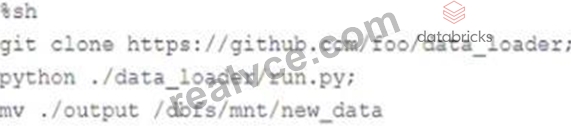
The code executes successfully and provides the logically correct results, however, it takes over
20 minutes to extract and load around 1 GB of data.
Which statement is a possible explanation for this behavior?
- A. %sh executes shell code on the driver node. The code does not take advantage of the worker nodes or Databricks optimized Spark.
- B. %sh does not distribute file moving operations; the final line of code should be updated to use %fs instead.
- C. Python will always execute slower than Scala on Databricks. The run.py script should be refactored to Scala.
- D. %sh triggers a cluster restart to collect and install Git. Most of the latency is related to cluster startup time.
- E. Instead of cloning, the code should use %sh pip install so that the Python code can get executed in parallel across all nodes in a cluster.
Answer: A
Explanation:
https://www.databricks.com/blog/2020/08/31/introducing-the-databricks-web-terminal.html The code is using %sh to execute shell code on the driver node. This means that the code is not taking advantage of the worker nodes or Databricks optimized Spark. This is why the code is taking longer to execute. A better approach would be to use Databricks libraries and APIs to read and write data from Git and DBFS, and to leverage the parallelism and performance of Spark. For example, you can use the Databricks Connect feature to run your Python code on a remote Databricks cluster, or you can use the Spark Git Connector to read data from Git repositories as Spark DataFrames.
NEW QUESTION # 47
A Spark job is taking longer than expected. Using the Spark UI, a data engineer notes that the Min, Median, and Max Durations for tasks in a particular stage show the minimum and median time to complete a task as roughly the same, but the max duration for a task to be roughly 100 times as long as the minimum.
Which situation is causing increased duration of the overall job?
- A. Task queueing resulting from improper thread pool assignment.
- B. Spill resulting from attached volume storage being too small.
- C. Network latency due to some cluster nodes being in different regions from the source data
- D. Skew caused by more data being assigned to a subset of spark-partitions.
- E. Credential validation errors while pulling data from an external system.
Answer: D
Explanation:
This is the correct answer because skew is a common situation that causes increased duration of the overall job. Skew occurs when some partitions have more data than others, resulting in uneven distribution of work among tasks and executors. Skew can be caused by various factors, such as skewed data distribution, improper partitioning strategy, or join operations with skewed keys. Skew can lead to performance issues such as long-running tasks, wasted resources, or even task failures due to memory or disk spills.
NEW QUESTION # 48
An upstream source writes Parquet data as hourly batches to directories named with the current date. A nightly batch job runs the following code to ingest all data from the previous day as indicated by the date variable:
Get Latest & Actual Certified-Data-Engineer-Professional Exam's Question and Answers from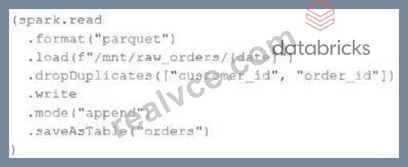
Assume that the fields customer_id and order_id serve as a composite key to uniquely identify each order.
If the upstream system is known to occasionally produce duplicate entries for a single order hours apart, which statement is correct?
- A. Each write to the orders table will only contain unique records, and only those records without duplicates in the target table will be written.
- B. Each write to the orders table will run deduplication over the union of new and existing records, ensuring no duplicate records are present.
- C. Each write to the orders table will only contain unique records; if existing records with the same key are present in the target table, the operation will tail.
- D. Each write to the orders table will only contain unique records, but newly written records may have duplicates already present in the target table.
- E. Each write to the orders table will only contain unique records; if existing records with the same key are present in the target table, these records will be overwritten.
Answer: D
Explanation:
This is the correct answer because the code uses the dropDuplicates method to remove any duplicate records within each batch of data before writing to the orders table. However, this method does not check for duplicates across different batches or in the target table, so it is possible that newly written records may have duplicates already present in the target table. To avoid this, a better approach would be to use Delta Lake and perform an upsert operation using mergeInto.
NEW QUESTION # 49
A data engineer needs to capture pipeline settings from an existing in the workspace, and use them to create and version a JSON file to create a new pipeline. Which command should the data engineer enter in a web terminal configured with the Databricks CLI?
- A. Use the alone command to create a copy of an existing pipeline; use the get JSON command to get the pipeline definition; save this to git
- B. Stop the existing pipeline; use the returned settings in a reset command
- C. Use the get command to capture the settings for the existing pipeline; remove the pipeline_id and rename the pipeline; use this in a create command
- D. Use list pipelines to get the specs for all pipelines; get the pipeline spec from the return results parse and use this to create a pipeline
Answer: C
Explanation:
The Databricks CLI provides a way to automate interactions with Databricks services. When dealing with pipelines, you can use the databricks pipelines get --pipeline-id command to capture the settings of an existing pipeline in JSON format. This JSON can then be modified by removing the pipeline_id to prevent conflicts and renaming the pipeline to create a new pipeline. The modified JSON file can then be used with the databricks pipelines create command to create a new pipeline with those settings.
Get Latest & Actual Certified-Data-Engineer-Professional Exam's Question and Answers from
NEW QUESTION # 50
A small company based in the United States has recently contracted a consulting firm in India to implement several new data engineering pipelines to power artificial intelligence applications. All the company's data is stored in regional cloud storage in the United States.
The workspace administrator at the company is uncertain about where the Databricks workspace used by the contractors should be deployed.
Assuming that all data governance considerations are accounted for, which statement accurately informs this decision?
- A. Databricks notebooks send all executable code from the user's browser to virtual machines over the open internet; whenever possible, choosing a workspace region near the end users is the most secure.
- B. Databricks runs HDFS on cloud volume storage; as such, cloud virtual machines must be deployed in the region where the data is stored.
- C. Databricks workspaces do not rely on any regional infrastructure; as such, the decision should be Get Latest & Actual Certified-Data-Engineer-Professional Exam's Question and Answers from made based upon what is most convenient for the workspace administrator.
- D. Databricks leverages user workstations as the driver during interactive development; as such, users should always use a workspace deployed in a region they are physically near.
- E. Cross-region reads and writes can incur significant costs and latency; whenever possible, compute should be deployed in the same region the data is stored.
Answer: E
Explanation:
This is the correct answer because it accurately informs this decision. The decision is about where the Databricks workspace used by the contractors should be deployed. The contractors are based in India, while all the company's data is stored in regional cloud storage in the United States. When choosing a region for deploying a Databricks workspace, one of the important factors to consider is the proximity to the data sources and sinks. Cross-region reads and writes can incur significant costs and latency due to network bandwidth and data transfer fees.
Therefore, whenever possible, compute should be deployed in the same region the data is stored to optimize performance and reduce costs.
NEW QUESTION # 51
The DevOps team has configured a production workload as a collection of notebooks scheduled to run daily using the Jobs Ul. A new data engineering hire is onboarding to the team and has requested access to one of these notebooks to review the production logic. What are the maximum notebook permissions that can be granted to the user without allowing accidental changes to production code or data?
- A. Can Read
- B. Can run
- C. Can edit
- D. Can manage
Answer: A
Explanation:
Granting a user 'Can Read' permissions on a notebook within Databricks allows them to view the notebook's content without the ability to execute or edit it. This level of permission ensures that the new team member can review the production logic for learning or auditing purposes without the risk of altering the notebook's code or affecting production data and workflows. This approach aligns with best practices for maintaining security and integrity in production environments, where strict access controls are essential to prevent unintended modifications.
NEW QUESTION # 52
The view updates represents an incremental batch of all newly ingested data to be inserted or updated in the customers table.
The following logic is used to process these records.
Get Latest & Actual Certified-Data-Engineer-Professional Exam's Question and Answers from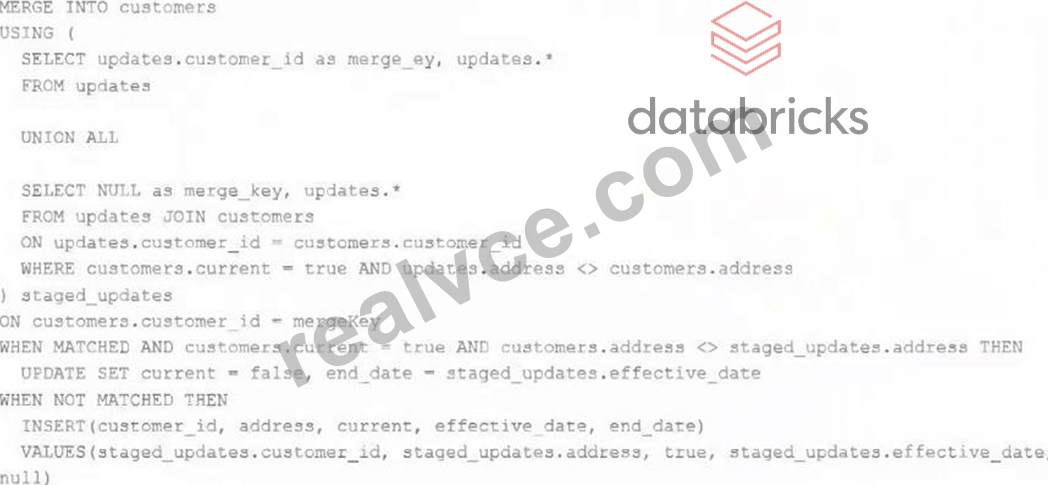
Which statement describes this implementation?
- A. The customers table is implemented as a Type 0 table; all writes are append only with no changes to existing values.
- B. The customers table is implemented as a Type 2 table; old values are overwritten and new customers are appended.
- C. The customers table is implemented as a Type 1 table; old values are overwritten by new values and no history is maintained.
- D. The customers table is implemented as a Type 3 table; old values are maintained as a new column alongside the current value.
- E. The customers table is implemented as a Type 2 table; old values are maintained but marked as no longer current and new values are inserted.
Answer: E
NEW QUESTION # 53
A team of data engineer are adding tables to a DLT pipeline that contain repetitive expectations for many of the same data quality checks.
One member of the team suggests reusing these data quality rules across all tables defined for this pipeline.
What approach would allow them to do this?
- A. Add data quality constraints to tables in this pipeline using an external job with access to pipeline configuration files.
- B. Maintain data quality rules in a Delta table outside of this pipeline's target schema, providing the schema name as a pipeline parameter.
- C. Maintain data quality rules in a separate Databricks notebook that each DLT notebook of file.
- D. Use global Python variables to make expectations visible across DLT notebooks included in the same pipeline.
Answer: B
Explanation:
Maintaining data quality rules in a centralized Delta table allows for the reuse of these rules across multiple DLT (Delta Live Tables) pipelines. By storing these rules outside the pipeline's target schema and referencing the schema name as a pipeline parameter, the team can apply the same set of data quality checks to different tables within the pipeline. This approach ensures consistency in data quality validations and reduces redundancy in code by not having to replicate the same rules in each DLT notebook or file.
NEW QUESTION # 54
The data governance team has instituted a requirement that all tables containing Personal Identifiable Information (PH) must be clearly annotated. This includes adding column comments, table comments, and setting the custom table property "contains_pii" = true.
The following SQL DDL statement is executed to create a new table:
Get Latest & Actual Certified-Data-Engineer-Professional Exam's Question and Answers from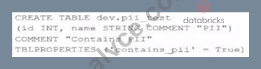
Which command allows manual confirmation that these three requirements have been met?
- A. DESCRIBE EXTENDED dev.pii test
- B. DESCRIBE HISTORY dev.pii test
- C. SHOW TABLES dev
- D. SHOW TBLPROPERTIES dev.pii test
- E. DESCRIBE DETAIL dev.pii test
Answer: A
Explanation:
This is the correct answer because it allows manual confirmation that these three requirements have been met. The requirements are that all tables containing Personal Identifiable Information (PII) must be clearly annotated, which includes adding column comments, table comments, and setting the custom table property "contains_pii" = true. The DESCRIBE EXTENDED command is used to display detailed information about a table, such as its schema, location, properties, and comments. By using this command on the dev.pii_test table, one can verify that the table has been created with the correct column comments, table comment, and custom table property as specified in the SQL DDL statement.
NEW QUESTION # 55
The Databricks CLI is use to trigger a run of an existing job by passing the job_id parameter. The response that the job run request has been submitted successfully includes a filed run_id.
Get Latest & Actual Certified-Data-Engineer-Professional Exam's Question and Answers from Which statement describes what the number alongside this field represents?
- A. The globally unique ID of the newly triggered run.
- B. The total number of jobs that have been run in the workspace.
- C. The job_id is returned in this field.
- D. The number of times the job definition has been run in the workspace.
- E. The job_id and number of times the job has been are concatenated and returned.
Answer: A
Explanation:
When triggering a job run using the Databricks CLI, the run_id field in the response represents a globally unique identifier for that particular run of the job. This run_id is distinct from the job_id.
While the job_id identifies the job definition and is constant across all runs of that job, the run_id is unique to each execution and is used to track and query the status of that specific job run within the Databricks environment. This distinction allows users to manage and reference individual executions of a job directly.
NEW QUESTION # 56
A Delta Lake table representing metadata about content from user has the following schema:
Based on the above schema, which column is a good candidate for partitioning the Delta Table?
- A. Date
- B. latitude
- C. Post_id
- D. User_id
- E. Post_time
Answer: A
Explanation:
Partitioning a Delta Lake table improves query performance by organizing data into partitions based on the values of a column. In the given schema, the date column is a good candidate for partitioning for several reasons:
Time-Based Queries: If queries frequently filter or group by date, partitioning by the date column can significantly improve performance by limiting the amount of data scanned. Granularity: The date column likely has a granularity that leads to a reasonable number of partitions (not too many and not too few). This balance is important for optimizing both read and write performance.
Data Skew: Other columns like post_id or user_id might lead to uneven partition sizes (data skew), which can negatively impact performance.
Get Latest & Actual Certified-Data-Engineer-Professional Exam's Question and Answers from Partitioning by post_time could also be considered, but typically date is preferred due to its more manageable granularity.
NEW QUESTION # 57
......
Verified Databricks-Certified-Data-Engineer-Professional dumps Q&As Latest Databricks-Certified-Data-Engineer-Professional Download: https://www.realvce.com/Databricks-Certified-Data-Engineer-Professional_free-dumps.html
Databricks-Certified-Data-Engineer-Professional Dumps with Free 365 Days Update Fast Exam Updates: https://drive.google.com/open?id=1AEadGT3bKghZgCGJej-Almm9TPmzUrQa