


Free Jun-2026 UPDATED Salesforce B2C-Commerce-Architect Exam Questions & Answer
Latest Success Metrics For Actual B2C-Commerce-Architect Exam Realistic Dumps
Salesforce is a well-known cloud-based software company that provides a wide range of customer relationship management (CRM) solutions for businesses of all sizes. One of the most popular products of Salesforce is its B2C-Commerce-Architect platform, which allows businesses to create personalized online storefronts and deliver seamless digital experiences to their customers. To demonstrate their expertise in this platform, Salesforce offers a certification exam called the Salesforce Certified B2C Commerce Architect.
To become a Salesforce Certified B2C Commerce Architect, candidates must pass the Salesforce B2C-Commerce-Architect exam. B2C-Commerce-Architect exam consists of 60 multiple-choice questions and has a time limit of 105 minutes. Candidates must achieve a passing score of 75% or higher to earn the certification. B2C-Commerce-Architect exam covers topics such as architecture, data modeling, integrations, site design, and site management.
The Salesforce Certified B2C Commerce Architect certification also validates the candidate's ability to design and architect complex eCommerce solutions that meet the unique requirements of their clients. Successful candidates are able to lead and manage large-scale, multi-functional teams that are responsible for implementing B2C Commerce solutions. Salesforce Certified B2C Commerce Architect certification is ideal for professionals who are looking to advance their careers in the eCommerce domain and want to demonstrate their proficiency in the B2C Commerce platform.
NEW QUESTION # 37
An Order Management System (OMS) handles orders from multiple brand specific sites, as part of the processing, the OMS sends the processing detail to be added at notes to the orders in B2C Commerce. These processing details are captured temporarily in custom objects, and are later processed by a batch Job that:
* Processes the custom object to extract the orderid and note data.
* Tries to load the order.
* If the order is not found, it deletes the custom object and moves on.
* If the order is found, it updates notes In the Order, upon successful update of this order, it deletes the custom object.
There is an Issue reported that the job is constantly failing and custom objects are growing in number. On investigating the production look the message below is being logged on each failure:
What are three solution The Architect can take to fix this issue without losing meaningful data?
Choose 3 answers
- A. Take the backup of the custom object and delete the custom object to ensure on the next job run the custom objects are getting processed.
- B. Take the backup of the Order as XML and delete the Order to ensure on the next job run, the custom objects are getting processed.
- C. Using BM site import/export, soften the
<quota id=''object.orderPo.relation,notes''> <custom-action>warn<custom-action> </quots> to make sure that neither order notes are lost and custom object is processed. - D. Engage B2C Commerce Support Team to soften the quota limit for ''object.OrderPO.relation.notes''
- E. Take the backup of the Order as XML and delete the notes from Order to ensure on the next job run the custom objects are getting processed.
Answer: C,D,E
NEW QUESTION # 38
An Architect has been asked by the Business to integrate a newpayment LINK cartridge. As part of the integration, the Architect has created four new services to access various endpoints in the integration.
How can the Architect move the new services to Production when the integration is ready for launch?
- A. The new services will be moved to Production with a Code Replication.
- B. The new services will be moved to production with a Site Import.
- C. The new services must be manually exported from staging and Imported into Production.
- D. The new services will be moved to Production with a Data Replication.
Answer: A
Explanation:
For deploying new services related to a payment LINK cartridge to Production, the correct method is through Code Replication (D). This approach ensures that all new code changes, including the integration services, are consistently applied across different environments. Code replication covers deploying all changes made in code, scripts, and service configurations from a staging or development environment to the production environment. This process ensures that all new functionalities are tested in a controlled environment before being moved to production, reducing the risk of errors affecting the live site.
NEW QUESTION # 39
A Retailer has a single storefront site and a Product Management System (PIM). The Pin is Generating the master catalog and storefront categorization catalog every day and it uploading them to SFTP how should the Architect configure the import job flows following the best practices?
- A. 1st flow is assigned to the site to download the files from SFTP. 2nd flow is assigned to the site to Import the master catalog. 3rd flow K global to Import the storefront catalog.
- B. 1st flow is global to download the files horn SFTP. 2nd flow is global to import the master catalog. 3rd flow Is global to Import the storefront catalog.
- C. 1st flow is assigned to the site to download the files from SFTP. 2nd flow is assigned to the site to Import the storefront catalog 3rd flow It global to Import the master catalog.
- D. 1st flow is global to download the files from SFTP. 2nd flow is global to import the storefront catalog
3rd flow K global to Import the master catalog.
Answer: B
NEW QUESTION # 40
Northern Trail Outfitters (NTO) wants to bring data from across all parts of their Salesforce Customer Success Platform Into the Marketing Cloud account. A Solution Architect recommends using Synchronized Data Sources In Contact Builder and Marketing Cloud Connect to Integrate multiple business units In their account.
Which API does the Solution Architect need to use with Marketing Cloud Connect for this integration?
- A. Streaming API
- B. Tooling API
- C. SOAP API
- D. REST API
Answer: D
NEW QUESTION # 41
An integration cartridge implements communication between the B2C Commerce Storefront and a third-party service provider. The cartridge contains the localServiceRegistry code: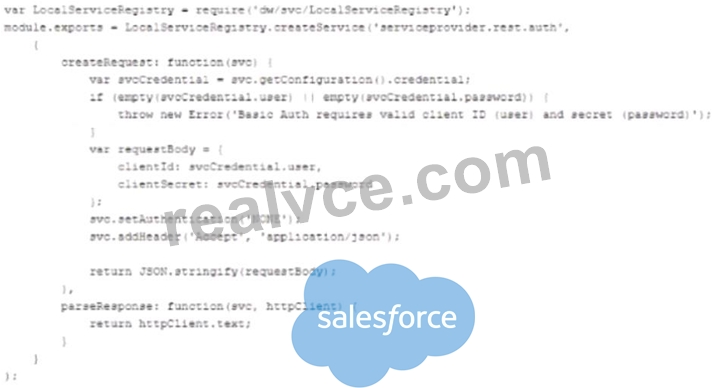
How does this code sample accomplish authentication to the service provider?
- A. By disabling Basic Auth and executing the service authentication call.
- B. By performing a signed SOAP Auth request using a certificate.
- C. By wrapping the authentication service call with Basic Auth.
- D. By Issuing a Basic Auth request to the service provider.
Answer: D
NEW QUESTION # 42
A B2C Commerce Developer has just finished implementing a new promotion code form on checkout. During review, an Architect notes that the form it not using CSRF validation correctly.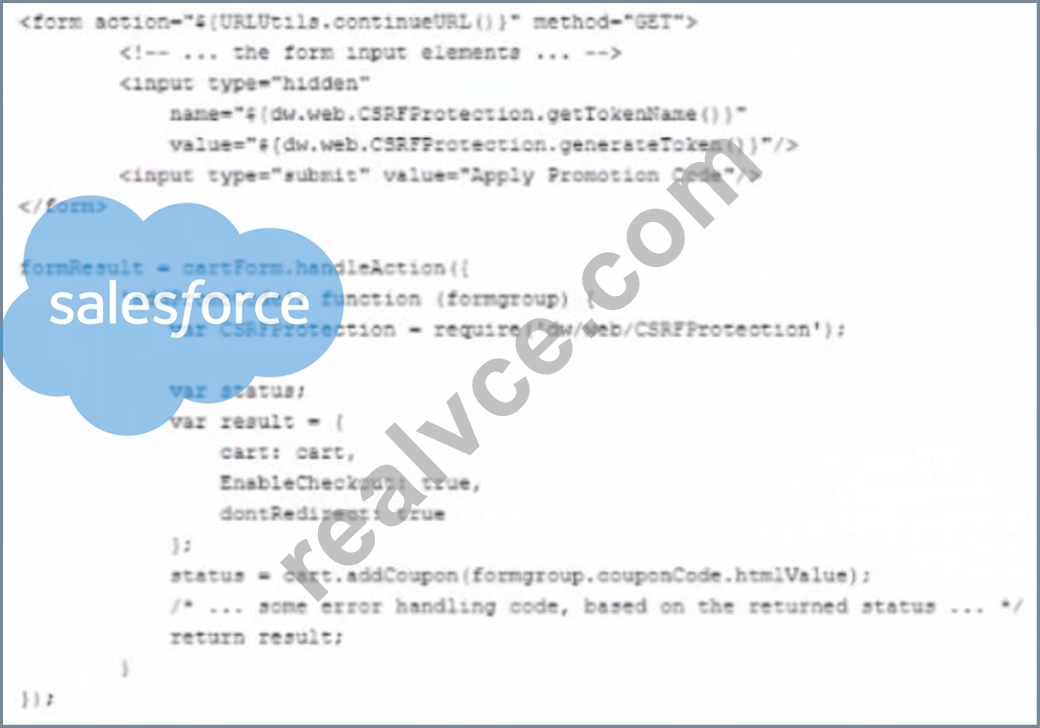
Which two options are best practice recommendations for dealing with CSRF validation? Choose 2 answers
- A. Only use POST methods over HTTPS.
- B. Automatically renew the CSRF Token if expired.
- C. Only use GET methods over HTTPS.
- D. Ensure the CSRF protection is validated on form submission.
Answer: A,D
NEW QUESTION # 43
Northern Trail Outfitters (NTO) wants to migrate its online shoo from a custom ecommerce platform to B2C Commerce. NTO needs to migrate several thousands of customer records profile information, address book).
WTO can provide a B2C Commerce feed. It is currently using SHA-2S6 as an encryption mechanism for the customer passwords.
What approach can the Architect propose?
- A. Import the customer records, with the hashed password as a custom attribute, and during the login compare the entered password with the hashed password and save it in the password field.
- B. Import the customer records, including the hashed password, as B2C Commerce supports SHA-2S6, and they will be able to login with their existing password.
- C. Do not import customer records and asks customers to create new accounts the first fame they try to log in to the B2C Commerce storefront.
- D. Import the customer records, excluding the password field, and B2C Commerce will automatically require a password reset the first time a customer logs m to the storefront.
Answer: B
NEW QUESTION # 44
A Retailer has a single storefront site and a Product Management System (PIM). The Pin is Generating the master catalog and storefront categorization catalog every day and it uploading them toSFTP how should the Architect configure the import job flows following the best practices?
- A. 1st flow is assigned to the site to download the files from SFTP. 2nd flow is assigned to the site to Import the master catalog. 3rd flow K global to Import the storefront catalog.
- B. 1st flow is assigned to the site to download the files from SFTP. 2nd flow is assigned to the site to Import the storefront catalog 3rd flow It global to Import the master catalog.
- C. 1st flow is global to download the files from SFTP. 2nd flow is global to import the storefront catalog
3rd flow K global to Import the master catalog. - D. 1st flow is global to download the files horn SFTP. 2nd flow is global to import the master catalog. 3rd flow Is global to Import the storefront catalog.
Answer: C
Explanation:
For optimal job flow concerning data import from a PIM system, the sequence should begin with downloading files globally from an SFTP site, followed by importing data into the B2C Commerce platform:
* First flow: Download files, ensuring all required files are available and ready for import.
* Second flow: Import the storefront catalog which likely has dependencies on the master catalog but is generally smaller and can be updated more rapidly.
* Third flow: Import the master catalog, as it typically contains the foundational data needed for various site functionalities.
This sequence respects data dependency and integrity, ensuring that the storefront reflects the most current and accurate information after all relevant data is imported.
NEW QUESTION # 45
The client provided these business requirements:
* The B2C Commerce storefront will integrate with the client's Order Management System (OMS).
* The storefront will provide reel-time order export of successfully pieced orders The OMS supports both web service export end SFTP batch order export, but the client has expressed concern about the availability of the OMS.
Which two solutions satisfy the requirements and address the OMS reliability concern?
Choose 2 answers
- A. implement a batch export of orders via web service, excluding exported orders. This runs as a scheduled Job with an hourly run rate end marksprocessed orders as exported upon success.
- B. Implement a live export of orders during checkout vie web service, marking the processed order as exported when the AM returns successfully.
- C. Implement a batch export of orders to SFTP, excluding exported orders. This runs as a scheduled fc>b with a high-frequency run rate end marks processed orders as exported upon success.
- D. Implement a Live export of orders during checkout via SFTP, marking the processed order as exported when it has completed successfully.
Answer: A,C
Explanation:
Given the concerns about the reliability of the OMS, implementing scheduled batch exports ensures that order data is not lost due to potential OMS downtime and allows for reattempting failed exports. Option B uses SFTP for a high-frequency batch export, which can be scheduled to run multiple times a day, ensuring minimal delay in order synchronization while marking orders as exported upon successful transmission. Option C provides a similar safeguard but via web service, which can be scheduled to run hourly. Both methods enable tracking of export status and can handle temporary downtimes by reattempting the export until successful, aligning with the need for reliability in integration processes.
NEW QUESTION # 46
The Client wants to offer custom made container products on its new B2C Commerce storefront. TheClient provided two business requirements.
* Customer can specify container length, width, and height.
* Customer can specify the material that the container is made of.
The Client also provided the Architect a current data schema (shown below) for reference while preparing the technical documentation.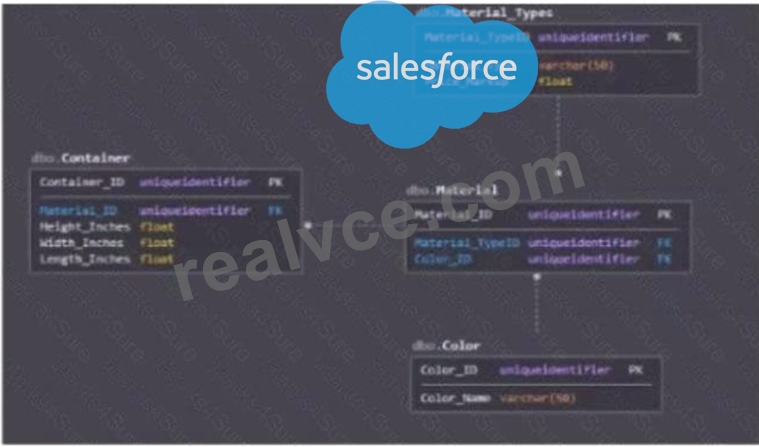
Which two gaps between the requirements and the data schema should the Architect discuss with the Client?
Choose 2 answers
- A. The data schema includes a Color_ID field, but there isn't a business requirement to allow the customer to specify container color.
- B. The data schema includes unique identifiers for material and color fields,but neither are reflected in the business requirements.
- C. The data schema includes a material Price_Markup field, but there Isn't a business requirement to factor the material cost Into the final price calculation.
- D. The data schema includes an implied structure that the customer's choices should be captured as custom objects, but there isn't a business requirement to do so
Answer: A,B
Explanation:
The provided data schema includes several fields that do not match the stated business requirements, which focus on the custom dimensions and materials of the containers:
* Option A: The inclusion of unique identifiers for materials and color fields in the data schema suggests a level of detail and structure around these attributes that is not reflected in the business requirements. If the business does not require tracking or differentiating materials beyond just naming them, this might be unnecessarily complex.
* Option D: The data schema includes a Color_ID field, which implies the ability to specify the color of the container. However, the business requirements do not mention color as a customization option available to customers. This discrepancy needs to be addressed to ensure that the database design aligns with actual business needs.
NEW QUESTION # 47
During the monitoring tasks you realize that a third party integration with your storefront is logging sensitive dat a. What can we do to avoid saving this information to the system logs?
- A. Implement getRequestLogMessage method for the ServiceCallback and remove sensitive data.
- B. Add a new log category for this service with level greater than the sensitive data is added to avoid logging.
- C. Implement filterResponseLogMessage method for the ServiceCallback to filter response log messages.
- D. Implement filterLogMessage method for the ServiceCallback to filter response log messages.
Answer: D
NEW QUESTION # 48
As a Commerce Architect you should ensure that the cache hit ratio for your storefront is over 70%. During your investigation you realize that a significant number of pages are not cached. From which tool can you get this information?
- A. Google Lighthouse
- B. Reports & Dashboard
- C. Pipeline Profiler
- D. Code Profiler
- E. Page Speed
Answer: B
NEW QUESTION # 49
A client has a single site with multiple domains, locales, and languages. After launch, there is a need for the client to perform offlinemaintenance. The client would like to show the same maintenance page for each locale.
Which version of aliases,Json file below will accomplish this task?
A)
B)
C)
D)
- A. Option A
- B. Option B
- C. Option C
- D. Option D
Answer: D
NEW QUESTION # 50
Facebook connect will be available on your storefront to allow users to log in. To configure properly the new OAuth provider. What should you need from your product owner?
- A. Ask for the access token.
- B. Send request to facebook endpoint with app_id sended by POST to retrieve the oauth token.
- C. Ask to grant needed permissions for your facebook user.
- D. User and password from Facebook to get the access token.
Answer: C
NEW QUESTION # 51
Which standards allow dw.ws.WebReference2 class?
- A. Apache CXF
- B. RPC/Encoded WSDLs
- C. WSDL 1.1
- D. https 1.0 and 1.1
- E. SOAP 1.1 and SOAP 1.2
Answer: A,C,D,E
NEW QUESTION # 52
The Architect has been presented with a requirement from the business to implement a new LINK cartridge.
The current site is built on the Storefront Reference Architecture, and the LINK cartridge is certified for Pipelines and Controllers. On review, the Architect notes that the Jobs are all created in Pipelines.
How should the Architect implement that cartridge to make sure the required jobs runs property?
- A. The job Pipelines must be updated to work as custom job steps.
- B. The Job Pipelines must be updated to use SiteGenesis Controllers.
- C. The job Pipelines must be updated to useSFRA Controllers.
- D. The job Pipelines must be removed and recreated with scripts.
Answer: A
NEW QUESTION # 53
An Architect is configuring a data replication schedule.
Which task(s) can be removed In order to reduce replication times?
- A. Static content
- B. Storefront URLs
- C. Search Indexes
- D. Campaign
Answer: A
Explanation:
Reducing the replication times in data synchronization can be effectively achieved by removing or reducing frequency of tasks that are less critical or that do not change frequently. Static content, such as images and static texts that do not change often, can be safely removed from frequent replication schedules (Answer B).
This adjustment will reduce the data load and frequency of updates, thereby speeding up the overall replication process. Unlike dynamic content like campaigns, search indexes, or URLs that might change frequently and impact user experience or site functionality if not updated, static content does not typically necessitate immediate replication, making it a suitable candidate for removal to enhance replication efficiency.
NEW QUESTION # 54
A client has a single site with multiple domains, locales, and languages. Afterlaunch, there is a need for the client to perform offline maintenance. The client would like to show the same maintenance page for each locale.
Which version of aliases,Json file below will accomplish this task?
- A.

- B.

- C.

- D.

Answer: C
Explanation:
Option C correctly addresses the requirement for showing the same maintenance page across multiple locales by having each different domain alias ("nto.eu", "nto.at", "nto.de") mapped to the same www domain ("www.
nto.eu"). This setup allows all traffic, regardless of the original locale-specific domain, to be directed to a single, unified maintenance page hosted under the "www.nto.eu" domain. This ensures consistency in the maintenance message presented to all users, irrespective of their regional domain.
NEW QUESTION # 55
The Client wants to offer custom made container products on its new B2C Commerce storefront. TheClient provided two business requirements.
* Customer can specify container length, width, and height.
* Customer can specify the material that the container is made of.
The Client also provided the Architect a current data schema (shown below) for reference while preparing the technical documentation.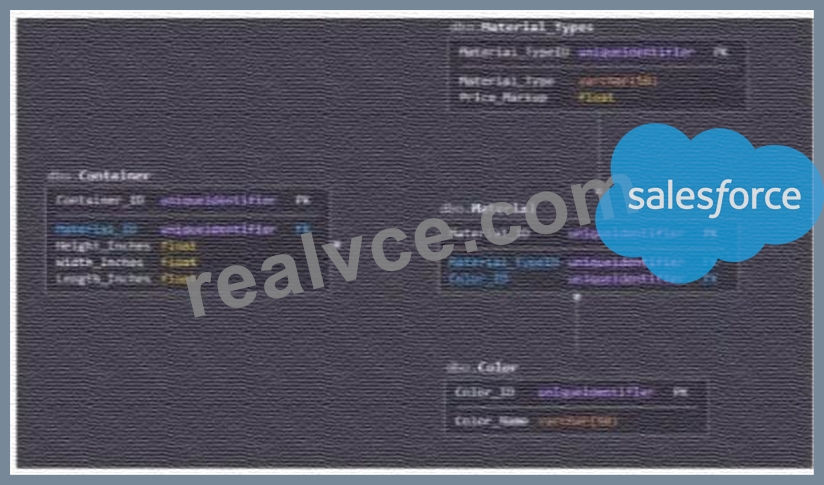
Which two gaps between the requirements and the data schema should the Architect discuss with the Client?
Choose 2 answers
- A. The data schema includes a material Price_Markup field, but there Isn't a business requirement to factor the material cost Into the final price calculation.
- B. The data schema includes unique identifiers for material and color fields,but neither are reflected in the business requirements.
- C. The data schema includes a Color_ID field, but there isn't a business requirement to allow the customer to specify container color.
- D. The data schema includes an implied structure that the customer's choices should be captured as custom objects, but there isn't a business requirement to do so
Answer: A,C
NEW QUESTION # 56
An Architect is performing an audit of production logs via Log Center and finds some potentially dangerous custom log output.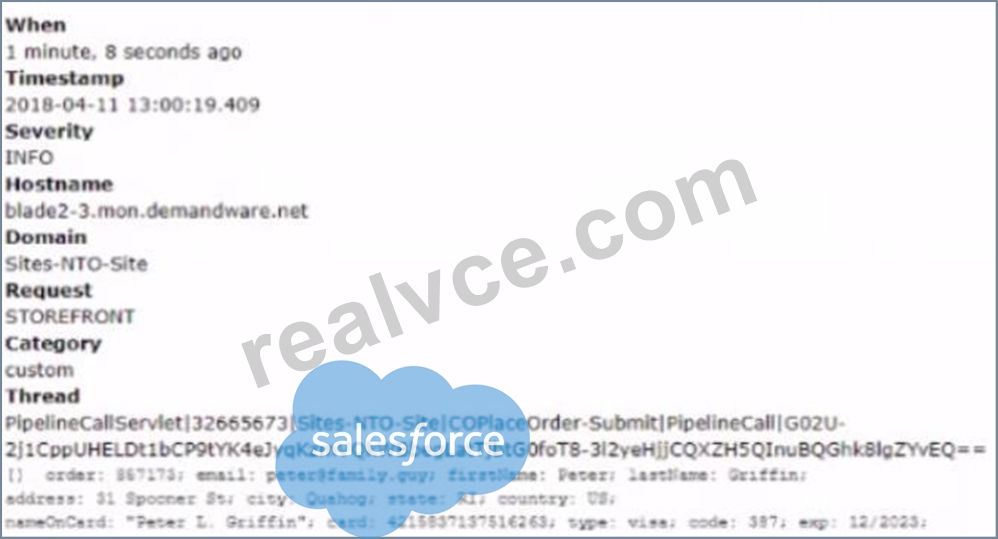
In which two ways It this log output Improper In a production environment? Choose 2 answers
- A. The log information includes the customer s card name as it appears along with the credit card number (PAN), which violates PCI.
- B. Information logs should not be used in a production environment
- C. The log information includes the order number and customer s email, which violates PCI.
- D. The log information includes the customer's card CW (card security code) and expiration date, which violates PCI.
Answer: A,C
NEW QUESTION # 57
Northern Trail Outfitters uses an Order Management system (OMS), which creates an order tracking number for every order 24 hours after receiving it. The OMS provides only a web-service interface to get this tracking number. There is a job that updates this tracking number for exported orders, which were last modified yesterday.
Part of this jobs code looks like the following:
Based on the above description and code snippet, which coding best practice should theArchitect enforce?
- A. Standard order import should be used instead of modifying multiple order objects with custom code.
- B. Configure circuit breaker and timeout for theOMS web service call to prevent thread exhaustion.
- C. Post-processing of search results is a bad practice that needs to be corrected.
- D. The transaction for updating of orders needs to be rewritten to avoid problems with transaction size.
Answer: B
Explanation:
Given that the OMS provides a web-service interface and updates tracking numbers for orders modified the previous day, it is crucial to manage the potential risks of service unavailability or delays that could lead to thread exhaustion in Salesforce Commerce Cloud. Implementing a circuit breaker pattern helps to manage failures gracefully by halting the interaction with the OMS if it becomes unresponsive, thereby preventing the service from impacting the entire system. Additionally, configuring timeouts ensures that the service calls do not hold up resources indefinitely. These strategies help maintain system stability and responsiveness, particularly when dealing with external systems over which there may be limited control.
NEW QUESTION # 58
......
Updated B2C-Commerce-Architect Dumps Questions For Salesforce Exam: https://www.realvce.com/B2C-Commerce-Architect_free-dumps.html
Best Value Available Preparation Guide for B2C-Commerce-Architect Exam: https://drive.google.com/open?id=1tl0fOZQH3GAnw3YocBnn0c-vJ7eIwjjr