


Free 2026 Generative AI Engineer Databricks-Generative-AI-Engineer-Associate dumps are available on Google Drive shared by RealVCE
Welcome to download the newest RealVCE Databricks-Generative-AI-Engineer-Associate PDF dumps: https://www.realvce.com/Databricks-Generative-AI-Engineer-Associate_free-dumps.html ( 75 Q&As)
NEW QUESTION # 22
A Generative AI Engineer is developing a chatbot designed to assist users with insurance-related queries. The chatbot is built on a large language model (LLM) and is conversational. However, to maintain the chatbot's focus and to comply with company policy, it must not provide responses to questions about politics. Instead, when presented with political inquiries, the chatbot should respond with a standard message:
"Sorry, I cannot answer that. I am a chatbot that can only answer questions around insurance." Which framework type should be implemented to solve this?
- A. Safety Guardrail
- B. Security Guardrail
- C. Contextual Guardrail
- D. Compliance Guardrail
Answer: A
Explanation:
In this scenario, the chatbot must avoid answering political questions and instead provide a standard message for such inquiries. Implementing aSafety Guardrailis the appropriate solution for this:
* What is a Safety Guardrail?Safety guardrails are mechanisms implemented in Generative AI systems to ensure the model behaves within specific bounds. In this case, it ensures the chatbot does not answer politically sensitive or irrelevant questions, which aligns with the business rules.
* Preventing Responses to Political Questions:The Safety Guardrail is programmed to detect specific types of inquiries (like political questions) and prevent the model from generating responses outside its intended domain. When such queries are detected, the guardrail intervenes and provides a pre-defined response: "Sorry, I cannot answer that. I am a chatbot that can only answer questions around insurance."
* How It Works in Practice:The LLM system can include aclassification layeror trigger rules based on specific keywords related to politics. When such terms are detected, the Safety Guardrail blocks the normal generation flow and responds with the fixed message.
* Why Other Options Are Less Suitable:
* B (Security Guardrail): This is more focused on protecting the system from security vulnerabilities or data breaches, not controlling the conversational focus.
* C (Contextual Guardrail): While context guardrails can limit responses based on context, safety guardrails are specifically about ensuring the chatbot stays within a safe conversational scope.
* D (Compliance Guardrail): Compliance guardrails are often related to legal and regulatory adherence, which is not directly relevant here.
Therefore, aSafety Guardrailis the right framework to ensure the chatbot only answers insurance-related queries and avoids political discussions.
NEW QUESTION # 23
A Generative AI Engineer is developing a chatbot designed to assist users with insurance-related queries. The chatbot is built on a large language model (LLM) and is conversational. However, to maintain the chatbot's focus and to comply with company policy, it must not provide responses to questions about politics. Instead, when presented with political inquiries, the chatbot should respond with a standard message:
"Sorry, I cannot answer that. I am a chatbot that can only answer questions around insurance." Which framework type should be implemented to solve this?
- A. Safety Guardrail
- B. Security Guardrail
- C. Contextual Guardrail
- D. Compliance Guardrail
Answer: A
Explanation:
In this scenario, the chatbot must avoid answering political questions and instead provide a standard message for such inquiries. Implementing a Safety Guardrail is the appropriate solution for this:
What is a Safety Guardrail?
Safety guardrails are mechanisms implemented in Generative AI systems to ensure the model behaves within specific bounds. In this case, it ensures the chatbot does not answer politically sensitive or irrelevant questions, which aligns with the business rules.
Preventing Responses to Political Questions:
The Safety Guardrail is programmed to detect specific types of inquiries (like political questions) and prevent the model from generating responses outside its intended domain. When such queries are detected, the guardrail intervenes and provides a pre-defined response: "Sorry, I cannot answer that. I am a chatbot that can only answer questions around insurance." How It Works in Practice:
The LLM system can include a classification layer or trigger rules based on specific keywords related to politics. When such terms are detected, the Safety Guardrail blocks the normal generation flow and responds with the fixed message.
Why Other Options Are Less Suitable:
B (Security Guardrail): This is more focused on protecting the system from security vulnerabilities or data breaches, not controlling the conversational focus.
C (Contextual Guardrail): While context guardrails can limit responses based on context, safety guardrails are specifically about ensuring the chatbot stays within a safe conversational scope.
D (Compliance Guardrail): Compliance guardrails are often related to legal and regulatory adherence, which is not directly relevant here.
Therefore, a Safety Guardrail is the right framework to ensure the chatbot only answers insurance-related queries and avoids political discussions.
NEW QUESTION # 24
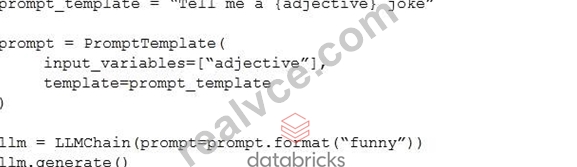
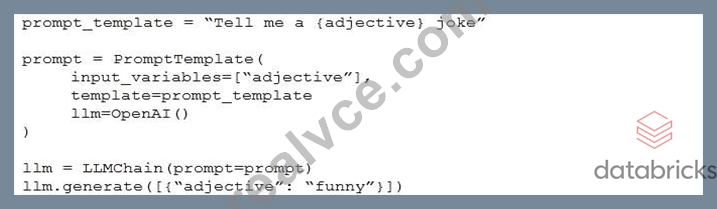
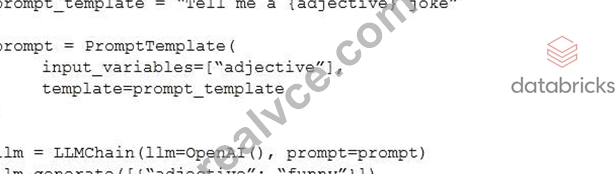
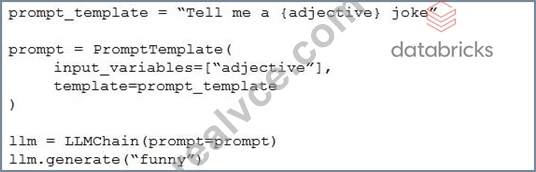
A Generative AI Engineer is testing a simple prompt template in LangChain using the code below, but is getting an error.
Assuming the API key was properly defined, what change does the Generative AI Engineer need to make to fix their chain?
- A.
- B.

- C.
- D.
Answer: C
Explanation:
To fix the error in the LangChain code provided for using a simple prompt template, the correct approach is Option C. Here's a detailed breakdown of why Option C is the right choice and how it addresses the issue:
* Proper Initialization: In Option C, the LLMChain is correctly initialized with the LLM instance specified as OpenAI(), which likely represents a language model (like GPT) from OpenAI. This is crucial as it specifies which model to use for generating responses.
* Correct Use of Classes and Methods:
* The PromptTemplate is defined with the correct format, specifying that adjective is a variable within the template. This allows dynamic insertion of values into the template when generating text.
* The prompt variable is properly linked with the PromptTemplate, and the final template string is passed correctly.
* The LLMChain correctly references the prompt and the initialized OpenAI() instance, ensuring that the template and the model are properly linked for generating output.
Why Other Options Are Incorrect:
* Option A: Misuses the parameter passing in generate method by incorrectly structuring the dictionary.
* Option B: Incorrectly uses prompt.format method which does not exist in the context of LLMChain and PromptTemplate configuration, resulting in potential errors.
* Option D: Incorrect order and setup in the initialization parameters for LLMChain, which would likely lead to a failure in recognizing the correct configuration for prompt and LLM usage.
Thus, Option C is correct because it ensures that the LangChain components are correctly set up and integrated, adhering to proper syntax and logical flow required by LangChain's architecture. This setup avoids common pitfalls such as type errors or method misuses, which are evident in other options.
NEW QUESTION # 25
A Generative AI Engineer is developing an LLM application that users can use to generate personalized birthday poems based on their names.
Which technique would be most effective in safeguarding the application, given the potential for malicious user inputs?
- A. Implement a safety filter that detects any harmful inputs and ask the LLM to respond that it is unable to assist
- B. Ask the LLM to remind the user that the input is malicious but continue the conversation with the user
- C. Increase the amount of compute that powers the LLM to process input faster
- D. Reduce the time that the users can interact with the LLM
Answer: A
Explanation:
In this case, the Generative AI Engineer is developing an application to generate personalized birthday poems, but there's a need to safeguard against malicious user inputs. The best solution is to implement a safety filter (option A) to detect harmful or inappropriate inputs.
Safety Filter Implementation:
Safety filters are essential for screening user input and preventing inappropriate content from being processed by the LLM. These filters can scan inputs for harmful language, offensive terms, or malicious content and intervene before the prompt is passed to the LLM.
Graceful Handling of Harmful Inputs:
Once the safety filter detects harmful content, the system can provide a message to the user, such as "I'm unable to assist with this request," instead of processing or responding to malicious input. This protects the system from generating harmful content and ensures a controlled interaction environment.
Why Other Options Are Less Suitable:
B (Reduce Interaction Time): Reducing the interaction time won't prevent malicious inputs from being entered.
C (Continue the Conversation): While it's possible to acknowledge malicious input, it is not safe to continue the conversation with harmful content. This could lead to legal or reputational risks.
D (Increase Compute Power): Adding more compute doesn't address the issue of harmful content and would only speed up processing without resolving safety concerns.
Therefore, implementing a safety filter that blocks harmful inputs is the most effective technique for safeguarding the application.
NEW QUESTION # 26
A small and cost-conscious startup in the cancer research field wants to build a RAG application using Foundation Model APIs.
Which strategy would allow the startup to build a good-quality RAG application while being cost-conscious and able to cater to customer needs?
- A. Pick a smaller LLM that is domain-specific
- B. Use the largest LLM possible because that gives the best performance for any general queries
- C. Limit the number of queries a customer can send per day
- D. Limit the number of relevant documents available for the RAG application to retrieve from
Answer: A
Explanation:
For a small, cost-conscious startup in the cancer research field, choosing a domain-specific and smaller LLM is the most effective strategy. Here's whyBis the best choice:
* Domain-specific performance: A smaller LLM that has been fine-tuned for the domain of cancer research will outperform a general-purpose LLM for specialized queries. This ensures high-quality responses without needing to rely on a large, expensive LLM.
* Cost-efficiency: Smaller models are cheaper to run, both in terms of compute resources and API usage costs. A domain-specific smaller LLM can deliver good quality responses without the need for the extensive computational power required by larger models.
* Focused knowledge: In a specialized field like cancer research, having an LLM tailored to the subject matter provides better relevance and accuracy for queries, while keeping costs low.Large, general- purpose LLMs may provide irrelevant information, leading to inefficiency and higher costs.
This approach allows the startup to balance quality, cost, and customer satisfaction effectively, making it the most suitable strategy.
NEW QUESTION # 27
A Generative Al Engineer is tasked with improving the RAG quality by addressing its inflammatory outputs.
Which action would be most effective in mitigating the problem of offensive text outputs?
- A. Inform the user of the expected RAG behavior
- B. Curate upstream data properly that includes manual review before it is fed into the RAG system
- C. Restrict access to the data sources to a limited number of users
- D. Increase the frequency of upstream data updates
Answer: B
Explanation:
Addressing offensive or inflammatory outputs in a Retrieval-Augmented Generation (RAG) system is critical for improving user experience and ensuring ethical AI deployment. Here's whyDis the most effective approach:
* Manual data curation: The root cause of offensive outputs often comes from the underlying data used to train the model or populate the retrieval system. By manually curating the upstream data and conducting thorough reviews before the data is fed into the RAG system, the engineer can filter out harmful, offensive, or inappropriate content.
* Improving data quality: Curating data ensures the system retrieves and generates responses from a high-quality, well-vetted dataset. This directly impacts the relevance and appropriateness of the outputs from the RAG system, preventing inflammatory content from being included in responses.
* Effectiveness: This strategy directly tackles the problem at its source (the data) rather than just mitigating the consequences (such as informing users or restricting access). It ensures that the system consistently provides non-offensive, relevant information.
Other options, such as increasing the frequency of data updates or informing users about behavior expectations, may not directly mitigate the generation of inflammatory outputs.
NEW QUESTION # 28
A team wants to serve a code generation model as an assistant for their software developers. It should support multiple programming languages. Quality is the primary objective.
Which of the Databricks Foundation Model APIs, or models available in the Marketplace, would be the best fit?
- A. Llama2-70b
- B. BGE-large
- C. CodeLlama-34B
- D. MPT-7b
Answer: C
Explanation:
For a code generation model that supports multiple programming languages and where quality is the primary objective,CodeLlama-34Bis the most suitable choice. Here's the reasoning:
* Specialization in Code Generation:CodeLlama-34B is specifically designed for code generation tasks.
This model has been trained with a focus on understanding and generating code, which makes it particularly adept at handling various programming languages and coding contexts.
* Capacity and Performance:The "34B" indicates a model size of 34 billion parameters, suggesting a high capacity for handling complex tasks and generating high-quality outputs. The large model size typically correlates with better understanding and generation capabilities in diverse scenarios.
* Suitability for Development Teams:Given that the model is optimized for code, it will be able to assist software developers more effectively than general-purpose models. It understands coding syntax, semantics, and the nuances of different programming languages.
* Why Other Options Are Less Suitable:
* A (Llama2-70b): While also a large model, it's more general-purpose and may not be as fine- tuned for code generation as CodeLlama.
* B (BGE-large): This model may not specifically focus on code generation.
* C (MPT-7b): Smaller than CodeLlama-34B and likely less capable in handling complex code generation tasks at high quality.
Therefore, for a high-quality, multi-language code generation application,CodeLlama-34B(option D) is the best fit.
NEW QUESTION # 29
A Generative Al Engineer is using an LLM to classify species of edible mushrooms based on text descriptions of certain features. The model is returning accurate responses in testing and the Generative Al Engineer is confident they have the correct list of possible labels, but the output frequently contains additional reasoning in the answer when the Generative Al Engineer only wants to return the label with no additional text.
Which action should they take to elicit the desired behavior from this LLM?
- A. Use a system prompt to instruct the model to be succinct in its answer
- B. Use zero shot chain-of-thought prompting to prevent a verbose output format
- C. Use few snot prompting to instruct the model on expected output format
- D. Use zero shot prompting to instruct the model on expected output format
Answer: A
Explanation:
The LLM classifies mushroom species accurately but includes unwanted reasoning text, and the engineer wants only the label. Let's assess how to control output format effectively.
Option A: Use few shot prompting to instruct the model on expected output format Few-shot prompting provides examples (e.g., input: description, output: label). It can work but requires crafting multiple examples, which is effort-intensive and less direct than a clear instruction.
Databricks Reference: "Few-shot prompting guides LLMs via examples, effective for format control but requires careful design" ("Generative AI Cookbook").
Option B: Use zero shot prompting to instruct the model on expected output format Zero-shot prompting relies on a single instruction (e.g., "Return only the label") without examples. It's simpler than few-shot but may not consistently enforce succinctness if the LLM's default behavior is verbose.
Databricks Reference: "Zero-shot prompting can specify output but may lack precision without examples" ("Building LLM Applications with Databricks").
Option C: Use zero shot chain-of-thought prompting to prevent a verbose output format Chain-of-Thought (CoT) encourages step-by-step reasoning, which increases verbosity-opposite to the desired outcome. This contradicts the goal of label-only output.
Databricks Reference: "CoT prompting enhances reasoning but often results in detailed responses" ("Databricks Generative AI Engineer Guide").
Option D: Use a system prompt to instruct the model to be succinct in its answer A system prompt (e.g., "Respond with only the species label, no additional text") sets a global instruction for the LLM's behavior. It's direct, reusable, and effective for controlling output style across queries.
Databricks Reference: "System prompts define LLM behavior consistently, ideal for enforcing concise outputs" ("Generative AI Cookbook," 2023).
Conclusion: Option D is the most effective and straightforward action, using a system prompt to enforce succinct, label-only responses, aligning with Databricks' best practices for output control.
NEW QUESTION # 30
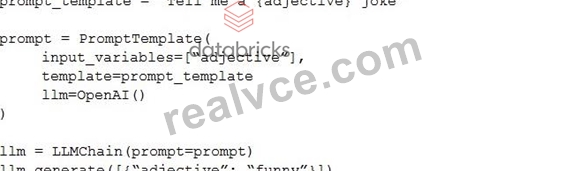
A Generative AI Engineer is testing a simple prompt template in LangChain using the code below, but is getting an error.
Assuming the API key was properly defined, what change does the Generative AI Engineer need to make to fix their chain?
- A.

- B.
- C.

- D.
Answer: B
Explanation:
To fix the error in the LangChain code provided for using a simple prompt template, the correct approach is Option C. Here's a detailed breakdown of why Option C is the right choice and how it addresses the issue:
Proper Initialization: In Option C, the LLMChain is correctly initialized with the LLM instance specified as OpenAI(), which likely represents a language model (like GPT) from OpenAI. This is crucial as it specifies which model to use for generating responses.
Correct Use of Classes and Methods:
The PromptTemplate is defined with the correct format, specifying that adjective is a variable within the template. This allows dynamic insertion of values into the template when generating text.
The prompt variable is properly linked with the PromptTemplate, and the final template string is passed correctly.
The LLMChain correctly references the prompt and the initialized OpenAI() instance, ensuring that the template and the model are properly linked for generating output.
Why Other Options Are Incorrect:
Option A: Misuses the parameter passing in generate method by incorrectly structuring the dictionary.
Option B: Incorrectly uses prompt.format method which does not exist in the context of LLMChain and PromptTemplate configuration, resulting in potential errors.
Option D: Incorrect order and setup in the initialization parameters for LLMChain, which would likely lead to a failure in recognizing the correct configuration for prompt and LLM usage.
Thus, Option C is correct because it ensures that the LangChain components are correctly set up and integrated, adhering to proper syntax and logical flow required by LangChain's architecture. This setup avoids common pitfalls such as type errors or method misuses, which are evident in other options.
NEW QUESTION # 31
What is an effective method to preprocess prompts using custom code before sending them to an LLM?
- A. It is better not to introduce custom code to preprocess prompts as the LLM has not been trained with examples of the preprocessed prompts
- B. Rather than preprocessing prompts, it's more effective to postprocess the LLM outputs to align the outputs to desired outcomes
- C. Write a MLflow PyFunc model that has a separate function to process the prompts
- D. Directly modify the LLM's internal architecture to include preprocessing steps
Answer: C
Explanation:
The most effective way to preprocess prompts using custom code is to write a custom model, such as an MLflow PyFunc model. Here's a breakdown of why this is the correct approach:
MLflow PyFunc Models:
MLflow is a widely used platform for managing the machine learning lifecycle, including experimentation, reproducibility, and deployment. A PyFunc model is a generic Python function model that can implement custom logic, which includes preprocessing prompts.
Preprocessing Prompts:
Preprocessing could include various tasks like cleaning up the user input, formatting it according to specific rules, or augmenting it with additional context before passing it to the LLM. Writing this preprocessing as part of a PyFunc model allows the custom code to be managed, tested, and deployed easily.
Modular and Reusable:
By separating the preprocessing logic into a PyFunc model, the system becomes modular, making it easier to maintain and update without needing to modify the core LLM or retrain it.
Why Other Options Are Less Suitable:
A (Modify LLM's Internal Architecture): Directly modifying the LLM's architecture is highly impractical and can disrupt the model's performance. LLMs are typically treated as black-box models for tasks like prompt processing.
B (Avoid Custom Code): While it's true that LLMs haven't been explicitly trained with preprocessed prompts, preprocessing can still improve clarity and alignment with desired input formats without confusing the model.
C (Postprocessing Outputs): While postprocessing the output can be useful, it doesn't address the need for clean and well-formatted inputs, which directly affect the quality of the model's responses.
Thus, using an MLflow PyFunc model allows for flexible and controlled preprocessing of prompts in a scalable way, making it the most effective method.
NEW QUESTION # 32
A Generative AI Engineer is creating an agent-based LLM system for their favorite monster truck team. The system can answer text based questions about the monster truck team, lookup event dates via an API call, or query tables on the team's latest standings.
How could the Generative AI Engineer best design these capabilities into their system?
- A. Write a system prompt for the agent listing available tools and bundle it into an agent system that runs a number of calls to solve a query.
- B. Instruct the LLM to respond with "RAG", "API", or "TABLE" depending on the query, then use text parsing and conditional statements to resolve the query.
- C. Ingest PDF documents about the monster truck team into a vector store and query it in a RAG architecture.
- D. Build a system prompt with all possible event dates and table information in the system prompt. Use a RAG architecture to lookup generic text questions and otherwise leverage the information in the system prompt.
Answer: A
Explanation:
In this scenario, the Generative AI Engineer needs to design a system that can handle different types of queries about the monster truck team. The queries may involve text-based information, API lookups for event dates, or table queries for standings. The best solution is to implement a tool-based agent system.
Here's how option B works, and why it's the most appropriate answer:
System Design Using Agent-Based Model:
In modern agent-based LLM systems, you can design a system where the LLM (Large Language Model) acts as a central orchestrator. The model can "decide" which tools to use based on the query. These tools can include API calls, table lookups, or natural language searches. The system should contain a system prompt that informs the LLM about the available tools.
System Prompt Listing Tools:
By creating a well-crafted system prompt, the LLM knows which tools are at its disposal. For instance, one tool may query an external API for event dates, another might look up standings in a database, and a third may involve searching a vector database for general text-based information. The agent will be responsible for calling the appropriate tool depending on the query.
Agent Orchestration of Calls:
The agent system is designed to execute a series of steps based on the incoming query. If a user asks for the next event date, the system will recognize this as a task that requires an API call. If the user asks about standings, the agent might query the appropriate table in the database. For text-based questions, it may call a search function over ingested data. The agent orchestrates this entire process, ensuring the LLM makes calls to the right resources dynamically.
Generative AI Tools and Context:
This is a standard architecture for integrating multiple functionalities into a system where each query requires different actions. The core design in option B is efficient because it keeps the system modular and dynamic by leveraging tools rather than overloading the LLM with static information in a system prompt (like option D).
Why Other Options Are Less Suitable:
A (RAG Architecture): While relevant, simply ingesting PDFs into a vector store only helps with text-based retrieval. It wouldn't help with API lookups or table queries.
C (Conditional Logic with RAG/API/TABLE): Although this approach works, it relies heavily on manual text parsing and might introduce complexity when scaling the system.
D (System Prompt with Event Dates and Standings): Hardcoding dates and table information into a system prompt isn't scalable. As the standings or events change, the system would need constant updating, making it inefficient.
By bundling multiple tools into a single agent-based system (as in option B), the Generative AI Engineer can best handle the diverse requirements of this system.
NEW QUESTION # 33
A Generative AI Engineer is designing a RAG application for answering user questions on technical regulations as they learn a new sport.
What are the steps needed to build this RAG application and deploy it?
- A. Ingest documents from a source -> Index the documents and save to Vector Search -> Evaluate model -> Deploy it using Model Serving
- B. User submits queries against an LLM -> Ingest documents from a source -> Index the documents and save to Vector Search -> LLM retrieves relevant documents -> LLM generates a response -> Evaluate model -> Deploy it using Model Serving
- C. Ingest documents from a source -> Index the documents and saves to Vector Search -> User submits queries against an LLM -> LLM retrieves relevant documents -> Evaluate model -> LLM generates a response -> Deploy it using Model Serving
- D. Ingest documents from a source -> Index the documents and save to Vector Search -> User submits queries against an LLM -> LLM retrieves relevant documents -> LLM generates a response -> Evaluate model -> Deploy it using Model Serving
Answer: D
Explanation:
The Generative AI Engineer needs to follow a methodical pipeline to build and deploy a Retrieval-Augmented Generation (RAG) application. The steps outlined in option B accurately reflect this process:
Ingest documents from a source: This is the first step, where the engineer collects documents (e.g., technical regulations) that will be used for retrieval when the application answers user questions.
Index the documents and save to Vector Search: Once the documents are ingested, they need to be embedded using a technique like embeddings (e.g., with a pre-trained model like BERT) and stored in a vector database (such as Pinecone or FAISS). This enables fast retrieval based on user queries.
User submits queries against an LLM: Users interact with the application by submitting their queries. These queries will be passed to the LLM.
LLM retrieves relevant documents: The LLM works with the vector store to retrieve the most relevant documents based on their vector representations.
LLM generates a response: Using the retrieved documents, the LLM generates a response that is tailored to the user's question.
Evaluate model: After generating responses, the system must be evaluated to ensure the retrieved documents are relevant and the generated response is accurate. Metrics such as accuracy, relevance, and user satisfaction can be used for evaluation.
Deploy it using Model Serving: Once the RAG pipeline is ready and evaluated, it is deployed using a model-serving platform such as Databricks Model Serving. This enables real-time inference and response generation for users.
By following these steps, the Generative AI Engineer ensures that the RAG application is both efficient and effective for the task of answering technical regulation questions.
NEW QUESTION # 34
A Generative Al Engineer is working with a retail company that wants to enhance its customer experience by automatically handling common customer inquiries. They are working on an LLM-powered Al solution that should improve response times while maintaining a personalized interaction. They want to define the appropriate input and LLM task to do this.
Which input/output pair will do this?
- A. Input: Customer reviews; Output Group the reviews by users and aggregate per-user average rating, then respond
- B. Input: Customer reviews: Output Classify review sentiment
- C. Input: Customer service chat logs; Output: Find the answers to similar questions and respond with a summary
- D. Input: Customer service chat logs; Output Group the chat logs by users, followed by summarizing each user's interactions, then respond
Answer: C
Explanation:
The task described in the question involves enhancing customer experience by automatically handling common customer inquiries using an LLM-powered AI solution. This requires the system to process input data (customer inquiries) and generate personalized, relevant responses efficiently. Let's evaluate the options step-by-step in the context of Databricks Generative AI Engineer principles, which emphasize leveraging LLMs for tasks like question answering, summarization, and retrieval-augmented generation (RAG).
* Option A: Input: Customer reviews; Output: Group the reviews by users and aggregate per-user average rating, then respond
* This option focuses on analyzing customer reviews to compute average ratings per user. While this might be useful for sentiment analysis or user profiling, it does not directly address the goal of handling common customer inquiries or improving response times for personalized interactions. Customer reviews are typically feedback data, not real-time inquiries requiring immediate responses.
* Databricks Reference: Databricks documentation on LLMs (e.g., "Building LLM Applications with Databricks") emphasizes that LLMs excel at tasks like question answering and conversational responses, not just aggregation or statistical analysis of reviews.
* Option B: Input: Customer service chat logs; Output: Group the chat logs by users, followed by summarizing each user's interactions, then respond
* This option uses chat logs as input, which aligns with customer service scenarios. However, the output-grouping by users and summarizing interactions-focuses on user-specific summaries rather than directly addressing inquiries. While summarization is an LLM capability, this approach lacks the specificity of finding answers to common questions, which is central to the problem.
* Databricks Reference: Per Databricks' "Generative AI Cookbook," LLMs can summarize text, but for customer service, the emphasis is on retrieval and response generation (e.g., RAG workflows) rather than user interaction summaries alone.
* Option C: Input: Customer service chat logs; Output: Find the answers to similar questions and respond with a summary
* This option uses chat logs (real customer inquiries) as input and tasks the LLM with identifying answers to similar questions, then providing a summarized response. This directly aligns with the goal of handling common inquiries efficiently while maintaining personalization (by referencing past interactions or similar cases). It leverages LLM capabilities like semantic search, retrieval, and response generation, which are core to Databricks' LLM workflows.
* Databricks Reference: From Databricks documentation ("Building LLM-Powered Applications," 2023), an exact extract states:"For customer support use cases, LLMs can be used to retrieve relevant answers from historical data like chat logs and generate concise, contextually appropriate responses."This matches Option C's approach of finding answers and summarizing them.
* Option D: Input: Customer reviews; Output: Classify review sentiment
* This option focuses on sentiment classification of reviews, which is a valid LLM task but unrelated to handling customer inquiries or improving response times in a conversational context.
It's more suited for feedback analysis than real-time customer service.
* Databricks Reference: Databricks' "Generative AI Engineer Guide" notes that sentiment analysis is a common LLM task, but it's not highlighted for real-time conversational applications like customer support.
Conclusion: Option C is the best fit because it uses relevant input (chat logs) and defines an LLM task (finding answers and summarizing) that meets the requirements of improving response times and maintaining personalized interaction. This aligns with Databricks' recommended practices for LLM-powered customer service solutions, such as retrieval-augmented generation (RAG) workflows.
NEW QUESTION # 35
A Generative Al Engineer would like an LLM to generate formatted JSON from emails. This will require parsing and extracting the following information: order ID, date, and sender email. Here's a sample email: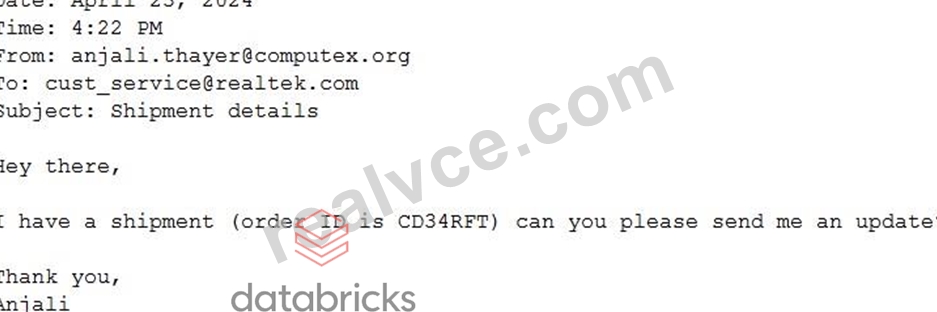
They will need to write a prompt that will extract the relevant information in JSON format with the highest level of output accuracy.
Which prompt will do that?
- A. You will receive customer emails and need to extract date, sender email, and order ID. Return the extracted information in JSON format.
- B. You will receive customer emails and need to extract date, sender email, and order ID. Return the extracted information in JSON format.
Here's an example: {"date": "April 16, 2024", "sender_email": "[email protected]", "order_id": "RE987D"} - C. You will receive customer emails and need to extract date, sender email, and order ID. Return the extracted information in a human-readable format.
- D. You will receive customer emails and need to extract date, sender email, and order ID. You should return the date, sender email, and order ID information in JSON format.
Answer: B
Explanation:
* Problem Context: The goal is to parse emails to extract certain pieces of information and output this in a structured JSON format. Clarity and specificity in the prompt design will ensure higher accuracy in the LLM's responses.
* Explanation of Options:
Option A: Provides a general guideline but lacks an example, which helps an LLM understand the exact format expected.
Option B: Includes a clear instruction and a specific example of the output format. Providing an example is crucial as it helps set the pattern and format in which the information should be structured, leading to more accurate results.
Option C: Does not specify that the output should be in JSON format, thus not meeting the requirement.
Option D: While it correctly asks for JSON format, it lacks an example that would guide the LLM on how to structure the JSON correctly.
Therefore, Option B is optimal as it not only specifies the required format but also illustrates it with an example, enhancing the likelihood of accurate extraction and formatting by the LLM.
NEW QUESTION # 36
A Generative Al Engineer has created a RAG application to look up answers to questions about a series of fantasy novels that are being asked on the author's web forum. The fantasy novel texts are chunked and embedded into a vector store with metadata (page number, chapter number, book title), retrieved with the user' s query, and provided to an LLM for response generation. The Generative AI Engineer used their intuition to pick the chunking strategy and associated configurations but now wants to more methodically choose the best values.
Which TWO strategies should the Generative AI Engineer take to optimize their chunking strategy and parameters? (Choose two.)
- A. Choose an appropriate evaluation metric (such as recall or NDCG) and experiment with changes in the chunking strategy, such as splitting chunks by paragraphs or chapters.
Choose the strategy that gives the best performance metric. - B. Change embedding models and compare performance.
- C. Pass known questions and best answers to an LLM and instruct the LLM to provide the best token count. Use a summary statistic (mean, median, etc.) of the best token counts to choose chunk size.
- D. Add a classifier for user queries that predicts which book will best contain the answer. Use this to filter retrieval.
- E. Create an LLM-as-a-judge metric to evaluate how well previous questions are answered by the most appropriate chunk. Optimize the chunking parameters based upon the values of the metric.
Answer: A,E
Explanation:
To optimize a chunking strategy for a Retrieval-Augmented Generation (RAG) application, the Generative AI Engineer needs a structured approach to evaluating the chunking strategy, ensuring that the chosen configuration retrieves the most relevant information and leads to accurate and coherent LLM responses.
Here's whyCandEare the correct strategies:
Strategy C: Evaluation Metrics (Recall, NDCG)
* Define an evaluation metric: Common evaluation metrics such as recall, precision, or NDCG (Normalized Discounted Cumulative Gain) measure how well the retrieved chunks match the user's query and the expected response.
* Recallmeasures the proportion of relevant information retrieved.
* NDCGis often used when you want to account for both the relevance of retrieved chunks and the ranking or order in which they are retrieved.
* Experiment with chunking strategies: Adjusting chunking strategies based on text structure (e.g., splitting by paragraph, chapter, or a fixed number of tokens) allows the engineer to experiment with various ways of slicing the text. Some chunks may better align with the user's query than others.
* Evaluate performance: By using recall or NDCG, the engineer can methodically test various chunking strategies to identify which one yields the highest performance. This ensures that the chunking method provides the most relevant information when embedding and retrieving data from the vector store.
Strategy E: LLM-as-a-Judge Metric
* Use the LLM as an evaluator: After retrieving chunks, the LLM can be used to evaluate the quality of answers based on the chunks provided. This could be framed as a "judge" function, where the LLM compares how well a given chunk answers previous user queries.
* Optimize based on the LLM's judgment: By having the LLM assess previous answers and rate their relevance and accuracy, the engineer can collect feedback on how well different chunking configurations perform in real-world scenarios.
* This metric could be a qualitative judgment on how closely the retrieved information matches the user's intent.
* Tune chunking parameters: Based on the LLM's judgment, the engineer can adjust the chunk size or structure to better align with the LLM's responses, optimizing retrieval for future queries.
By combining these two approaches, the engineer ensures that the chunking strategy is systematically evaluated using both quantitative (recall/NDCG) and qualitative (LLM judgment) methods. This balanced optimization process results in improved retrieval relevance and, consequently, better response generation by the LLM.
NEW QUESTION # 37
A Generative Al Engineer is helping a cinema extend its website's chat bot to be able to respond to questions about specific showtimes for movies currently playing at their local theater. They already have the location of the user provided by location services to their agent, and a Delta table which is continually updated with the latest showtime information by location. They want to implement this new capability In their RAG application.
Which option will do this with the least effort and in the most performant way?
- A. Create a Feature Serving Endpoint from a FeatureSpec that references an online store synced from the Delta table. Query the Feature Serving Endpoint as part of the agent logic / tool implementation.
- B. Query the Delta table directly via a SQL query constructed from the user's input using a text-to-SQL LLM in the agent logic / tool
- C. Set up a task in Databricks Workflows to write the information in the Delta table periodically to an external database such as MySQL and query the information from there as part of the agent logic / tool implementation.
- D. implementation. Write the Delta table contents to a text column.then embed those texts using an embedding model and store these in the vector index Look up the information based on the embedding as part of the agent logic / tool implementation.
Answer: A
Explanation:
The task is to extend a cinema chatbot to provide movie showtime information using a RAG application, leveraging user location and a continuously updated Delta table, with minimal effort and high performance.
Let's evaluate the options.
* Option A: Create a Feature Serving Endpoint from a FeatureSpec that references an online store synced from the Delta table. Query the Feature Serving Endpoint as part of the agent logic / tool implementation
* Databricks Feature Serving provides low-latency access to real-time data from Delta tables via an online store. Syncing the Delta table to a Feature Serving Endpoint allows the chatbot to query showtimes efficiently, integrating seamlessly into the RAG agent'stool logic. This leverages Databricks' native infrastructure, minimizing effort and ensuring performance.
* Databricks Reference:"Feature Serving Endpoints provide real-time access to Delta table data with low latency, ideal for production systems"("Databricks Feature Engineering Guide," 2023).
* Option B: Query the Delta table directly via a SQL query constructed from the user's input using a text-to-SQL LLM in the agent logic / tool
* Using a text-to-SQL LLM to generate queries adds complexity (e.g., ensuring accurate SQL generation) and latency (LLM inference + SQL execution). While feasible, it's less performant and requires more effort than a pre-built serving solution.
* Databricks Reference:"Direct SQL queries are flexible but may introduce overhead in real-time applications"("Building LLM Applications with Databricks").
* Option C: Write the Delta table contents to a text column, then embed those texts using an embedding model and store these in the vector index. Look up the information based on the embedding as part of the agent logic / tool implementation
* Converting structured Delta table data (e.g., showtimes) into text, embedding it, and using vector search is inefficient for structured lookups. It's effort-intensive (preprocessing, embedding) and less precise than direct queries, undermining performance.
* Databricks Reference:"Vector search excels for unstructured data, not structured tabular lookups"("Databricks Vector Search Documentation").
* Option D: Set up a task in Databricks Workflows to write the information in the Delta table periodically to an external database such as MySQL and query the information from there as part of the agent logic / tool implementation
* Exporting to an external database (e.g., MySQL) adds setup effort (workflow, external DB management) and latency (periodic updates vs. real-time). It's less performant and more complex than using Databricks' native tools.
* Databricks Reference:"Avoid external systems when Delta tables provide real-time data natively"("Databricks Workflows Guide").
Conclusion: Option A minimizes effort by using Databricks Feature Serving for real-time, low-latency access to the Delta table, ensuring high performance in a production-ready RAG chatbot.
NEW QUESTION # 38
A Generative Al Engineer at an automotive company would like to build a question-answering chatbot for customers to inquire about their vehicles. They have a database containing various documents of different vehicle makes, their hardware parts, and common maintenance information.
Which of the following components will NOT be useful in building such a chatbot?
- A. Response-generating LLM
- B. Embedding model
- C. Invite users to submit long, rather than concise, questions
- D. Vector database
Answer: C
Explanation:
The task involves building a question-answering chatbot for an automotive company using a database of vehicle-related documents. The chatbot must efficiently process customer inquiries and provide accurate responses. Let's evaluate each component to determine which isnotuseful, per Databricks Generative AI Engineer principles.
* Option A: Response-generating LLM
* An LLM is essential for generating natural language responses to customer queries based on retrieved information. This is a core component of any chatbot.
* Databricks Reference:"The response-generating LLM processes retrieved context to produce coherent answers"("Building LLM Applications with Databricks," 2023).
* Option B: Invite users to submit long, rather than concise, questions
* Encouraging long questions is a user interaction design choice, not a technical component of the chatbot's architecture. Moreover, long, verbose questions can complicate intent detection and retrieval, reducing efficiency and accuracy-counter to best practices for chatbot design. Concise questions are typically preferred for clarity and performance.
* Databricks Reference: While not explicitly stated, Databricks' "Generative AI Cookbook" emphasizes efficient query processing, implying that simpler, focused inputs improve LLM performance. Inviting long questions doesn't align with this.
* Option C: Vector database
* A vector database stores embeddings of the vehicle documents, enabling fast retrieval of relevant information via semantic search. This is critical for a question-answering system with a large document corpus.
* Databricks Reference:"Vector databases enable scalable retrieval of context from large datasets"("Databricks Generative AI Engineer Guide").
* Option D: Embedding model
* An embedding model converts text (documents and queries) into vector representations for similarity search. It's a foundational component for retrieval-augmented generation (RAG) in chatbots.
* Databricks Reference:"Embedding models transform text into vectors, facilitating efficient matching of queries to documents"("Building LLM-Powered Applications").
Conclusion: Option B is not a usefulcomponentin building the chatbot. It's a user-facing suggestion rather than a technical building block, and it could even degrade performance by introducing unnecessary complexity. Options A, C, and D are all integral to a Databricks-aligned chatbot architecture.
NEW QUESTION # 39
A Generative AI Engineer at an automotive company would like to build a question-answering chatbot to help customers answer specific questions about their vehicles. They have:
A catalog with hundreds of thousands of cars manufactured since the 1960s Historical searches with user queries and successful matches Descriptions of their own cars in multiple languages They have already selected an open-source LLM and created a test set of user queries. They need to discard techniques that will not help them build the chatbot. Which do they discard?
- A. Setting chunk size to match the model's context window to maximize coverage
- B. Fine-tuning an embedding model on automotive terminology
- C. Implementing metadata filtering based on car models and years
- D. Adding few-shot examples for response generation
Answer: A
Explanation:
According to Generative AI engineering standards for Retrieval-Augmented Generation (RAG), chunking strategy is a critical optimization variable. Setting the chunk size to match the model's maximum context window (e.g., 4k or 8k tokens) is a poor practice and should be discarded. Large chunks introduce significant "noise" into the LLM's context, as only a small portion of a massive chunk usually contains the answer to a specific query. This leads to the "lost in the middle" phenomenon where LLMs struggle to extract relevant information from bloated contexts. Furthermore, large chunks reduce the precision of the vector search. Standard best practices involve using smaller, semantically meaningful chunks (typically 256-512 tokens) with overlap to maintain context. In contrast, metadata filtering (B) is essential for narrowing searches to specific car years, fine-tuning embeddings (C) improves retrieval accuracy for domain-specific technical terms, and few-shot examples (D) guide the LLM's output format and tone.
NEW QUESTION # 40
A Generative AI Engineer is creating an LLM-powered application that will need access to up-to-date news articles and stock prices.
The design requires the use of stock prices which are stored in Delta tables and finding the latest relevant news articles by searching the internet.
How should the Generative AI Engineer architect their LLM system?
- A. Query the Delta table for volatile stock prices and use an LLM to generate a search query to investigate potential causes of the stock volatility.
- B. Use an LLM to summarize the latest news articles and lookup stock tickers from the summaries to find stock prices.
- C. Create an agent with tools for SQL querying of Delta tables and web searching, provide retrieved values to an LLM for generation of response.
- D. Download and store news articles and stock price information in a vector store. Use a RAG architecture to retrieve and generate at runtime.
Answer: C
Explanation:
To build an LLM-powered system that accesses up-to-date news articles and stock prices, the best approach is to create an agent that has access to specific tools (option D).
Agent with SQL and Web Search Capabilities:
By using an agent-based architecture, the LLM can interact with external tools. The agent can query Delta tables (for up-to-date stock prices) via SQL and perform web searches to retrieve the latest news articles. This modular approach ensures the system can access both structured (stock prices) and unstructured (news) data sources dynamically.
Why This Approach Works:
SQL Queries for Stock Prices: Delta tables store stock prices, which the agent can query directly for the latest data.
Web Search for News: For news articles, the agent can generate search queries and retrieve the most relevant and recent articles, then pass them to the LLM for processing.
Why Other Options Are Less Suitable:
A (Summarizing News for Stock Prices): This convoluted approach would not ensure accuracy when retrieving stock prices, which are already structured and stored in Delta tables.
B (Stock Price Volatility Queries): While this could retrieve relevant information, it doesn't address how to obtain the most up-to-date news articles.
C (Vector Store): Storing news articles and stock prices in a vector store might not capture the real-time nature of stock data and news updates, as it relies on pre-existing data rather than dynamic querying.
Thus, using an agent with access to both SQL for querying stock prices and web search for retrieving news articles is the best approach for ensuring up-to-date and accurate responses.
NEW QUESTION # 41
A Generative Al Engineer has successfully ingested unstructured documents and chunked them by document sections. They would like to store the chunks in a Vector Search index. The current format of the dataframe has two columns: (i) original document file name (ii) an array of text chunks for each document.
What is the most performant way to store this dataframe?
- A. Flatten the dataframe to one chunk per row, create a unique identifier for each row, and save to a Delta table
- B. Store each chunk as an independent JSON file in Unity Catalog Volume. For each JSON file, the key is the document section name and the value is the array of text chunks for that section
- C. First create a unique identifier for each document, then save to a Delta table
- D. Split the data into train and test set, create a unique identifier for each document, then save to a Delta table
Answer: A
Explanation:
* Problem Context: The engineer needs an efficient way to store chunks of unstructured documents to facilitate easy retrieval and search. The current dataframe consists of document filenames and associated text chunks.
* Explanation of Options:
* Option A: Splitting into train and test sets is more relevant for model training scenarios and not directly applicable to storage for retrieval in a Vector Search index.
* Option B: Flattening the dataframe such that each row contains a single chunk with a unique identifier is the most performant for storage and retrieval. This structure aligns well with how data is indexed and queried in vector search applications, making it easier to retrieve specific chunks efficiently.
* Option C: Creating a unique identifier for each document only does not address the need to access individual chunks efficiently, which is critical in a Vector Search application.
* Option D: Storing each chunk as an independent JSON file creates unnecessary overhead and complexity in managing and querying large volumes of files.
OptionBis the most efficient and practical approach, allowing for streamlined indexing and retrieval processes in a Delta table environment, fitting the requirements of a Vector Search index.
NEW QUESTION # 42
......
Databricks Databricks-Generative-AI-Engineer-Associate Exam Syllabus Topics:
| Topic | Details |
|---|---|
| Topic 1 |
|
| Topic 2 |
|
| Topic 3 |
|
| Topic 4 |
|
Tested Material Used To Databricks-Generative-AI-Engineer-Associate: https://www.realvce.com/Databricks-Generative-AI-Engineer-Associate_free-dumps.html
Following are some new Databricks-Generative-AI-Engineer-Associate Real Exam Questions!: https://drive.google.com/open?id=17XJy____c4iWqE16GswF9pKiNoN0Xwm4