


100% Free JN0-351 Exam Dumps to Pass Exam Easily from RealVCE
Free JN0-351 Exam Questions JN0-351 Actual Free Exam Questions
Juniper JN0-351 Exam Syllabus Topics:
| Topic | Details |
|---|---|
| Topic 1 |
|
| Topic 2 |
|
| Topic 3 |
|
| Topic 4 |
|
| Topic 5 |
|
NEW QUESTION # 46
Which mechanism is used to share routes between routing tables?
- A. forwarding instances
- B. filter-based forwarding
- C. routing instances
- D. RIB groups
Answer: D
NEW QUESTION # 47
You are asked to explore adding BGP route reflectors to allow for increased scale in your core network. Which statement is correct in this scenario?
- A. Route reflectors require that the network is connected in a physical full mesh.
- B. Route reflectors are required whenever internal BGP (IBGP) sessions are needed.
- C. The cluster ID is required to prevent routing loops.
- D. The cluster ID is not required to use route reflectors.
Answer: C
NEW QUESTION # 48
Which two statements about BGP facilitate the prevention of routing loops within an autonomous system? (Choose two.)
- A. IBGP sessions must be configured as a physical full mesh.
- B. Routes learned from IBGP neighbors are only advertised to other IBGP neighbors.
- C. IBGP sessions must be configured as a logical full mesh.
- D. Routes learned from IBGP neighbors are not readvertised to other IBGP neighbors.
Answer: C,D
NEW QUESTION # 49
You are asked to change the setting for the LSAs age out back to the default value. In this scenario, which time interval will accomplish this task?
- A. 600 seconds
- B. 3600 seconds
- C. 1800 seconds
- D. 300 seconds
Answer: B
NEW QUESTION # 50
Which two statements about the firewall filter terms shown in the exhibit are true? (Choose two.)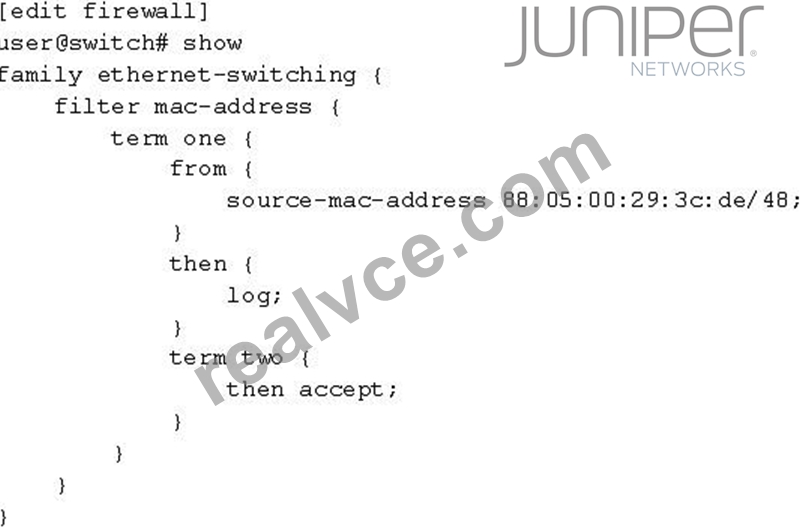
- A. Traffic matching the fromstatement in term twois logged.
- B. Traffic that matches the fromstatement in term oneis accepted.
- C. All traffic not matching the fromstatement in term oneis accepted by term two.
- D. Traffic that matches the fromstatement in term oneis discarded.
Answer: B,C
NEW QUESTION # 51
A recent security audit indicates that peer-to-peer applications are allowed on the guest VLAN and employees may have been using the guest VLAN for this purpose. You deploy the configuration shown in the exhibit, but it does not stop the peer-to-peer traffic.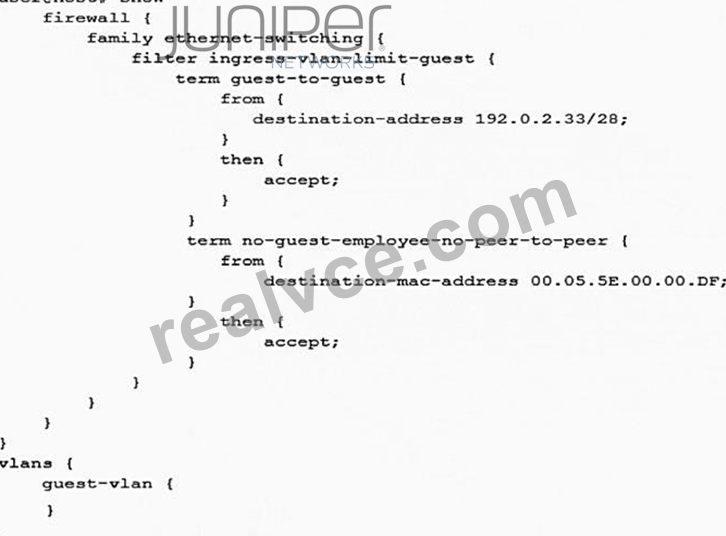
In this scenario, what must you do to implement the security policy?
- A. Deploy storm control to block unknown unicast traffic
- B. Implement 802.1X on the guest VLAN
- C. Attach the filter to the VLAN
- D. Use persistent MAC learning
Answer: C
NEW QUESTION # 52
Your switches are managed using Junos Space Network Director. You want to secure the switches using a Network Director filter profile. A filter profile containing one term shown in the exhibit is deployed to ports on managed devices.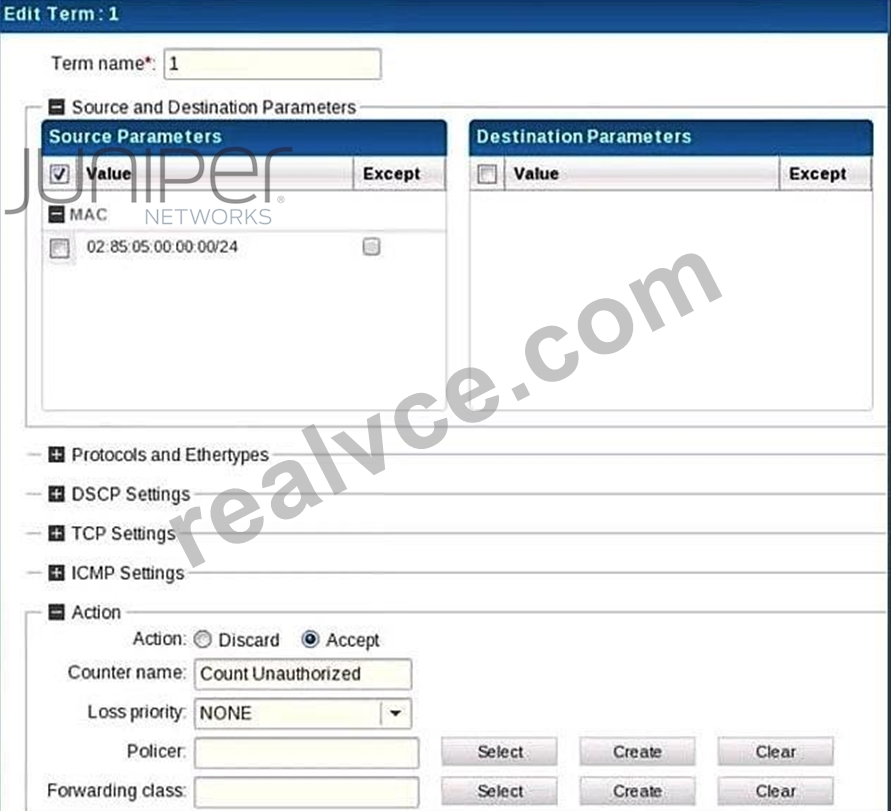
Which traffic will be accepted by the filter?
- A. No traffic will be accepted.
- B. All traffic will be accepted.
- C. Traffic containing a destination MAC of 02:85:05:00:00:00/24 will be accepted.
- D. Traffic containing a source MAC of 02:85:05:00:00:00/24 will be accepted.
Answer: D
NEW QUESTION # 53
Exhibit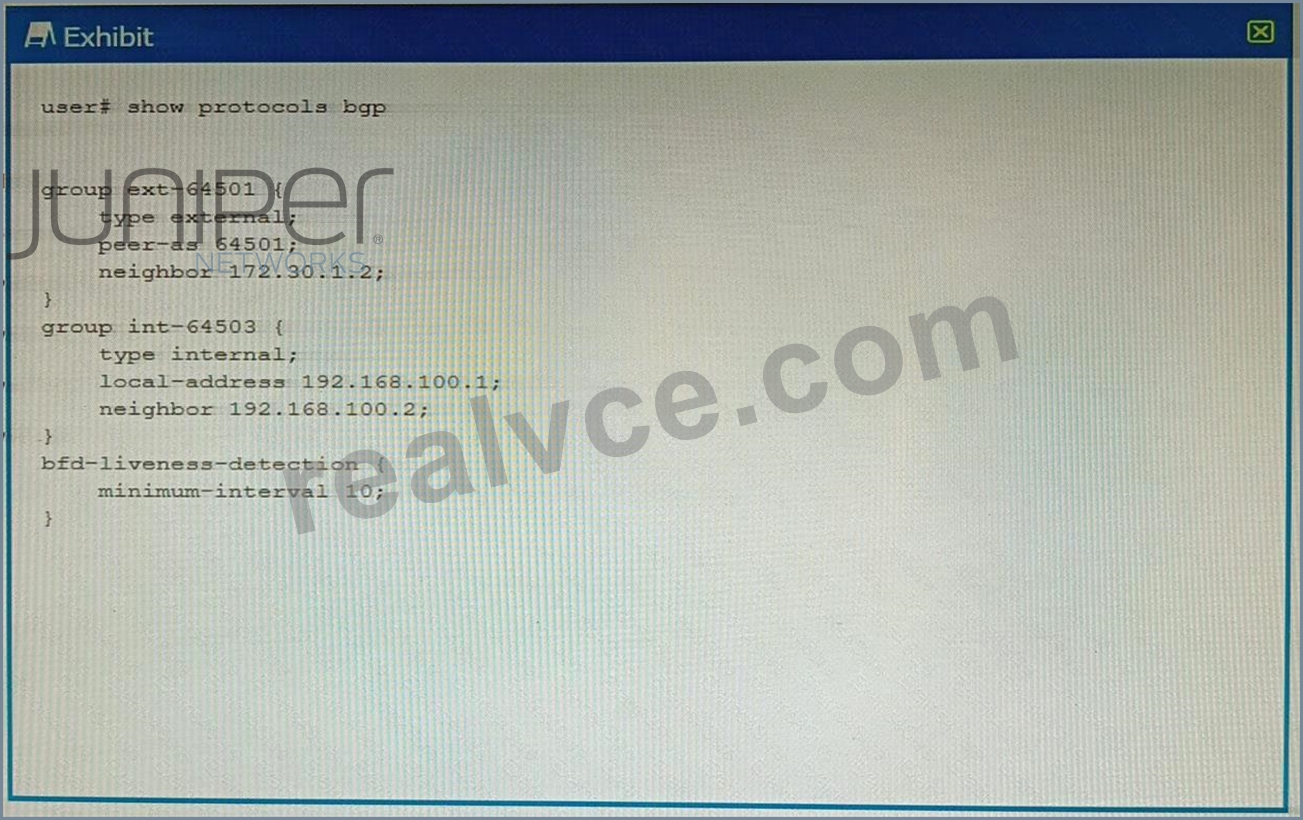
Your BGP neighbors, one in the USA and one in France, are not establishing a connection with each other.
Referring to the exhibit, which statement is correct?
- A. The BFD liveness must be configured on the BGP neighbor.
- B. The BFD liveness is set too low.
- C. The BFD liveness is set too high.
- D. The BFD liveness must be configured on the BGP group.
Answer: A
Explanation:
Explanation
The exhibit shows the configuration of BFD liveness detection for BGP at the global level, which applies to all BGP neighbors by default1. However, this configuration does not specify the session mode, which determines whether BFD uses single-hop or multihop mode to communicate with a neighbor2.
For single-hop BGP neighbors, which are directly connected on the same subnet, the session mode can be either automatic or single-hop. For multihop BGPneighbors, which are not directly connected and require multiple hops to reach, the session mode must be multihop2.
Since your BGP neighbors are in different countries, they are likely to be multihop neighbors. Therefore, you need to configure the session mode as multihop for each neighbor individually at the [edit protocols bgp group group-name neighbor address bfd-liveness-detection] hierarchy level2. For example:
protocols { bgp { group usa { neighbor 192.0.2.1 { bfd-liveness-detection { session-mode multihop; } } } group france { neighbor 198.51.100.1 { bfd-liveness-detection { session-mode multihop; } } } } } If you do not configure the session mode for multihop neighbors, BFD will use the default mode of automatic, which will try to use single-hop mode and fail to establish a BFD session with the remote neighbor2. This will prevent BGP from using BFD to detect liveliness and failover.
Therefore, the answer B is correct, as you need to configure the BFD liveness detection on the BGP neighbor level with the appropriate session mode for multihop neighbors.
NEW QUESTION # 54
Exhibit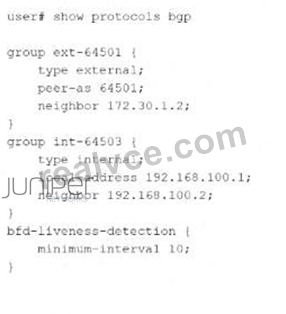
Your BGP neighbors, one in the USA and one in France, are not establishing a connection with each other.
Referring to the exhibit, which statement is correct?
- A. The BFD liveness must be configured on the BGP neighbor.
- B. The BFD liveness is set too low.
- C. The BFD liveness is set too high.
- D. The BFD liveness must be configured on the BGP group.
Answer: A
Explanation:
* The exhibit shows the configuration of BFD liveness detection for BGP at the global level, which applies to all BGP neighbors by default 1 . However, this configuration does not specify the session mode, which determines whether BFD uses single-hop or multihop mode to communicate with a neighbor 2 .
* For single-hop BGP neighbors, which are directly connected on the same subnet, the session mode can be either automatic or single-hop. For multihop BGP neighbors, which are not directly connected and require multiple hops to reach, the session mode must be multihop 2 .
* Since your BGP neighbors are in different countries, they are likely to be multihop neighbors. Therefore, you need to configure the session mode as multihop for each neighbor individually at the [edit protocols bgp group group-name neighbor address bfd-liveness-detection] hierarchy level 2 . For example:
protocols { bgp { group usa { neighbor 192.0.2.1 { bfd-liveness-detection { session-mode multihop; } } } group france { neighbor 198.51.100.1 { bfd-liveness-detection { session-mode multihop; } } } } }
* If you do not configure the session mode for multihop neighbors, BFD will use the default mode of automatic, which will try to use single-hop mode and fail to establish a BFD session with the remote neighbor 2 . This will prevent BGP from using BFD to detect liveliness and failover.
* Therefore, the answer B is correct, as you need to configure the BFD liveness detection on the BGP neighbor level with the appropriate session mode for multihop neighbors.
NEW QUESTION # 55
You are asked to change the setting for the LSAs age out back to the default value.
In this scenario, which time interval will accomplish this task?
- A. 600 seconds
- B. 3600 seconds
- C. 1800 seconds
- D. 300 seconds
Answer: B
Explanation:
https://www.juniper.net/documentation/us/en/software/junos/cli-reference/topics/ref/statement/lsa-refresh- interval-edit-protocols-ospf.html
NEW QUESTION # 56
Exhibit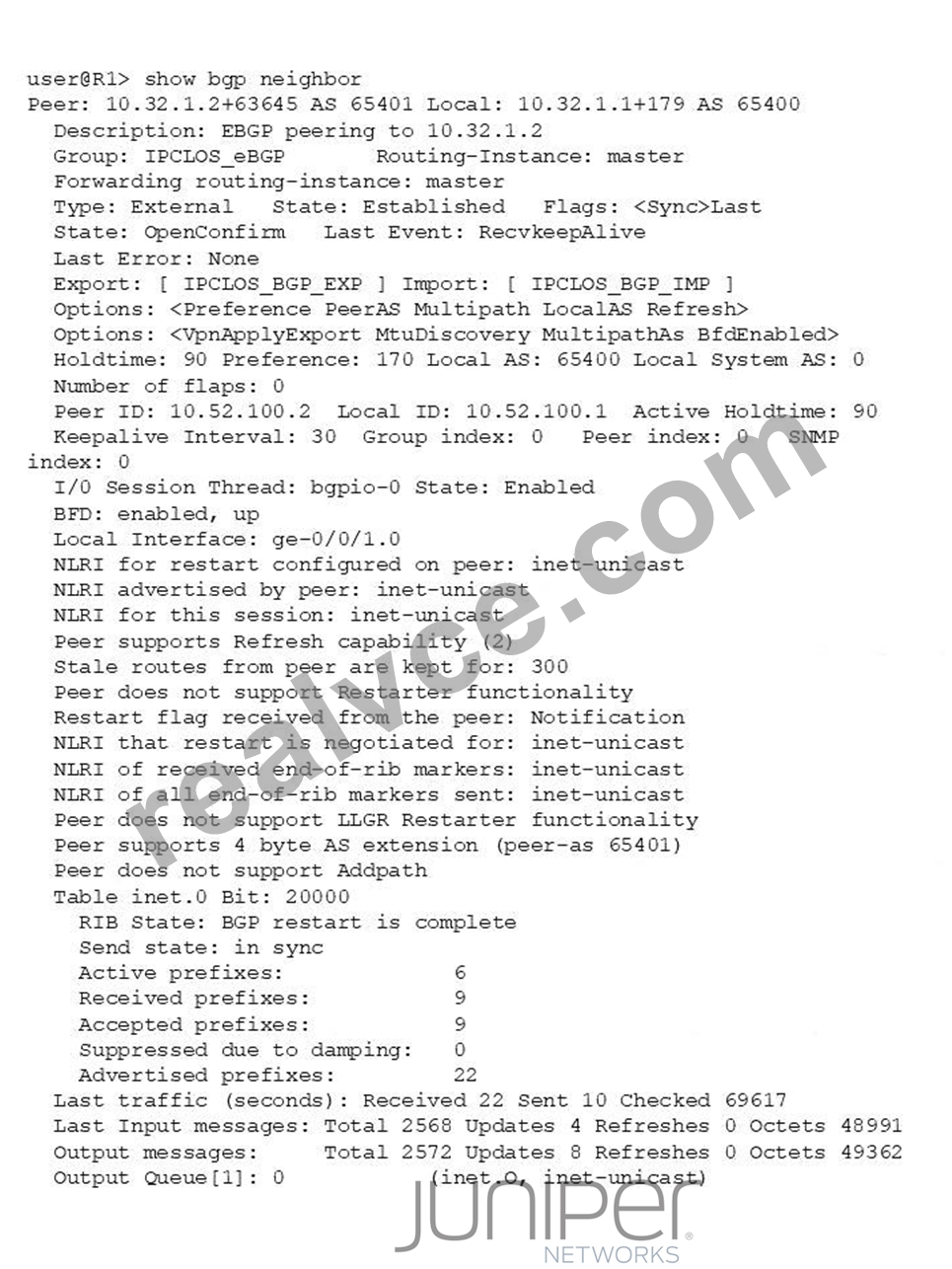
You are a network operator troubleshooting BGP connectivity.
Which two statements are correct about the output shown in the exhibit? (Choose two.)
- A. The R1 is configured for AS 65400.
- B. Peer 10.32.1.2 is configured for AS 63645.
- C. The BGP session is not established.
- D. The routers are exchanging IPv4 routes.
Answer: A,D
Explanation:
The output of the show bgp neighbor command shows the following information:
* The local AS number of R1 is 65400, as indicated by the line "Local: 10.32.1.1+179 AS 65400".
* The peer AS number of 10.32.1.2 is 63645, as indicated by the line "Peer: 10.32.1.2+179 AS 63645".
* The BGP session is established, as indicated by the line "State: Established".
* The routers are exchanging IPv4 routes, as indicated by the line "Type: External State: Established Flags: < Sync > " and the table showing the number of prefixes received and sent for inet.0 routing table. References: Enterprise Routing and Switching, Specialist (JNCIS-ENT) - Juniper Networks ,
[show bgp neighbor - Technical Documentation - Support - Juniper Networks]
NEW QUESTION # 57
Referring to the exhibit, which two configuration changes must you apply for packets to reach from R1 to R3 using IS-IS? (Choose two.)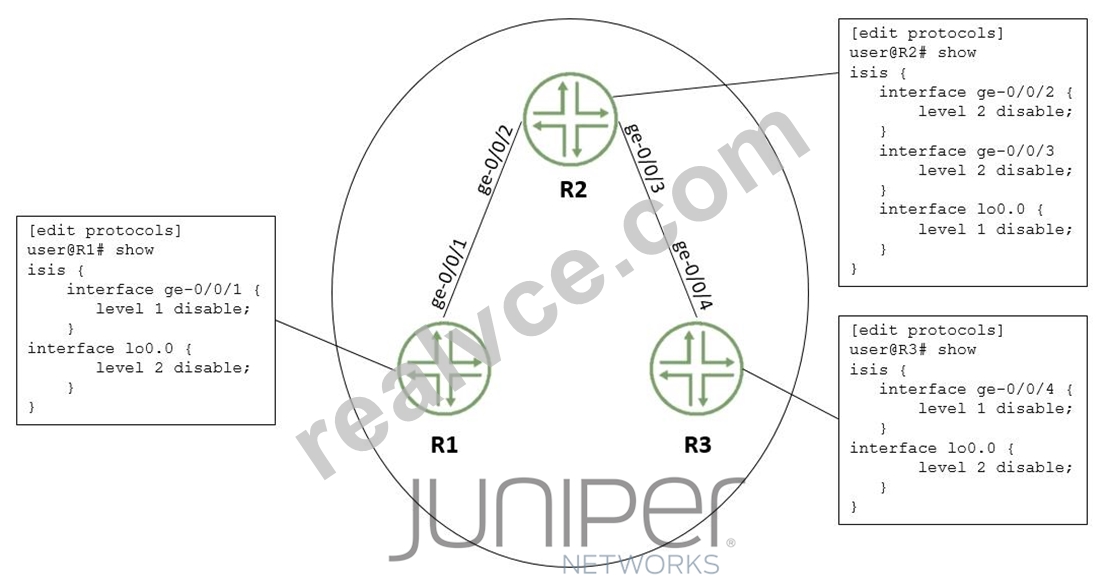
- A. On R3 disable Level 2 on the ge-0/0/4 interface.
- B. On R1, disable Level 2 on the ge-0/0/1 interface.
- C. On R3 enable Level 1 on the ge-0/0/4 interface
- D. On R1, enable Level 1 on the ge-0/0/1 interface.
Answer: C,D
Explanation:
A) On R1, enable Level 1 on the ge-0/0/1 interface. In IS-IS, both levels (Level 1 and Level 2) are enabled by default when you enable IS-IS on an interface1. Level 1 systems route within an area.
If the destination is outside an area, Level 1 systems route toward a Level 2 system. Therefore, enabling Level 1 on the ge-0/0/1 interface on R1 would allow packets to reach from R1 to R3.
D) On R3 enable Level 1 on the ge-0/0/4 interface Similarly, enabling Level 1 on the ge-0/0/4 interface on R3 would allow packets to reach from R1 to R3. These explanations are based on the IS-IS configuration documents and learning resources available at Juniper Networks1 and Cisco.
NEW QUESTION # 58
Which two statements are true about the default VLAN on Juniper switches? (Choose two.)
- A. The default VLAN ID is not assigned to any interface.
- B. The default VLAN is set to a VLAN ID of 1 by default
- C. The default VLAN ID is not visible.
- D. The default VLAN ID can be changed.
Answer: B,D
Explanation:
On Juniper switches, the default VLAN is set to a VLAN ID of 1 by default 1 2 . This means that all interfaces on the switch are members of VLAN 1 until they are specifically assigned to another VLAN 1 2 .
Therefore, option A is correct.
The default VLAN ID can be changed 1 2 . This allows network administrators to configure the switch to use a different VLAN as the default, if necessary 1 2 . Therefore, option D is correct.
NEW QUESTION # 59
Which statement is correct about controlling the routes installed by a RIB group?
- A. A firewall filter must be configured to install routes in the RIB groups.
- B. An import policy is applied to the RIB group.
- C. An export policy is applied to the RIB group.
- D. Only routes in the last table are installed.
Answer: B
Explanation:
Explanation
A RIB group is a configuration that allows a routing protocol to install routes into multiple routing tables in Junos OS. A RIB group consists of an import-rib statement,which specifies the source routing table, and an export-rib statement, which specifies the destination routing table or group. A RIB group can also include an import-policy statement, which specifies one or more policies to control which routes are imported into the destination routing table or group1.
An import policy is a policy statement that defines the criteria for accepting or rejecting routes from the source routing table. An import policy can also modify the attributes of the imported routes, such as preference, metric, or community. An import policy can be applied to a RIB group by using the import-policy statement under the [edit routing-options rib-groups] hierarchy level1.
Therefore, option A is correct, because an import policy is applied to the RIB group to control which routes are installed in the destination routing table or group. Option B is incorrect, because all routes in the source routing table are imported into the destination routing table or group, unless filtered by an import policy.
Option C is incorrect, because a firewall filter is not used to install routes in the RIB groups; a firewall filter is used to filter packets based on various criteria. Option D is incorrect, because an export policy is not applied to the RIB group; an export policy is applied to a routing protocol to control which routes are advertised to other devices.
References:
1: rib-groups | Junos OS | Juniper Networks
NEW QUESTION # 60
Which two multicast IP addresses are used for link-state update packets? (Choose two.)
- A. 224.0.0.6
- B. 224.0.0.5
- C. 224.0.0.9
- D. 224.0.0.10
Answer: A,B
Explanation:
Link-state update packets are used to flood link-state advertisements (LSAs) among OSPF routers. The destination IP address of these packets depends on the network type and the state of the interface. On broadcast and point-to-point networks, OSPF uses two IP multicast addresses: 224.0.0.5 for all OSPF routers and 224.0.0.6 for all designated routers (DRs) and backup designated routers (BDRs)12. If the interface state is DR or BDR, the link-state update packets are sent to 224.0.0.5. Otherwise, they are sent to 224.0.0.63. On non-broadcast networks, such as Frame Relay or ATM, link-state update packets are sent as unicasts to each adjacent neighbor3. Therefore, the correct answer is A and D. References: Understanding OSPF Areas | Junos OS, How OSPF Works - IP Routing [Book] - O'Reilly Media, Link state packet - Wikipedia
NEW QUESTION # 61
Exhibit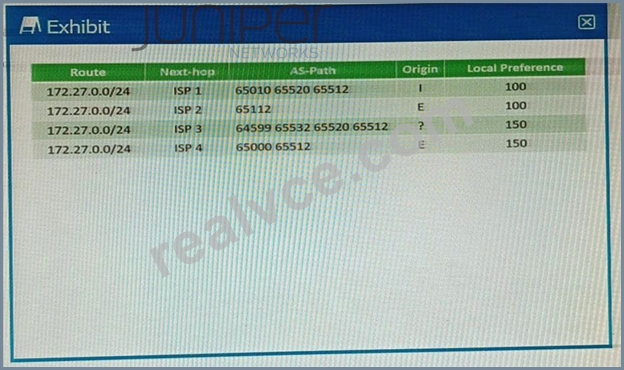
You are receiving the BGP route shown in the exhibit from four different upstream ISPs.
Referring to the exhibit, which ISP will be selected as the active path?
- A. ISP1
- B. ISP 2
- C. ISP 4
- D. ISP 3
Answer: C
Explanation:
Explanation
In BGP, the path selection process is based on a set of attributes1. The process starts by preferring the path with the highest weight, then the highest local preference, then the locally originated routes, and so on1. If all these attributes are the same, then it prefers the path with the shortest AS path1.
Referring to the exhibit, all four ISPs have the same weight, local preference, and origin1. However, ISP 4 has the shortest AS path1. Therefore, ISP 4 will be selected as the active path. So, option C is correct.
NEW QUESTION # 62
You have two OSPF routers that will not form an adjacency. You enter the show log trace- ospfcommand.
Referring to the exhibit, which statement is correct?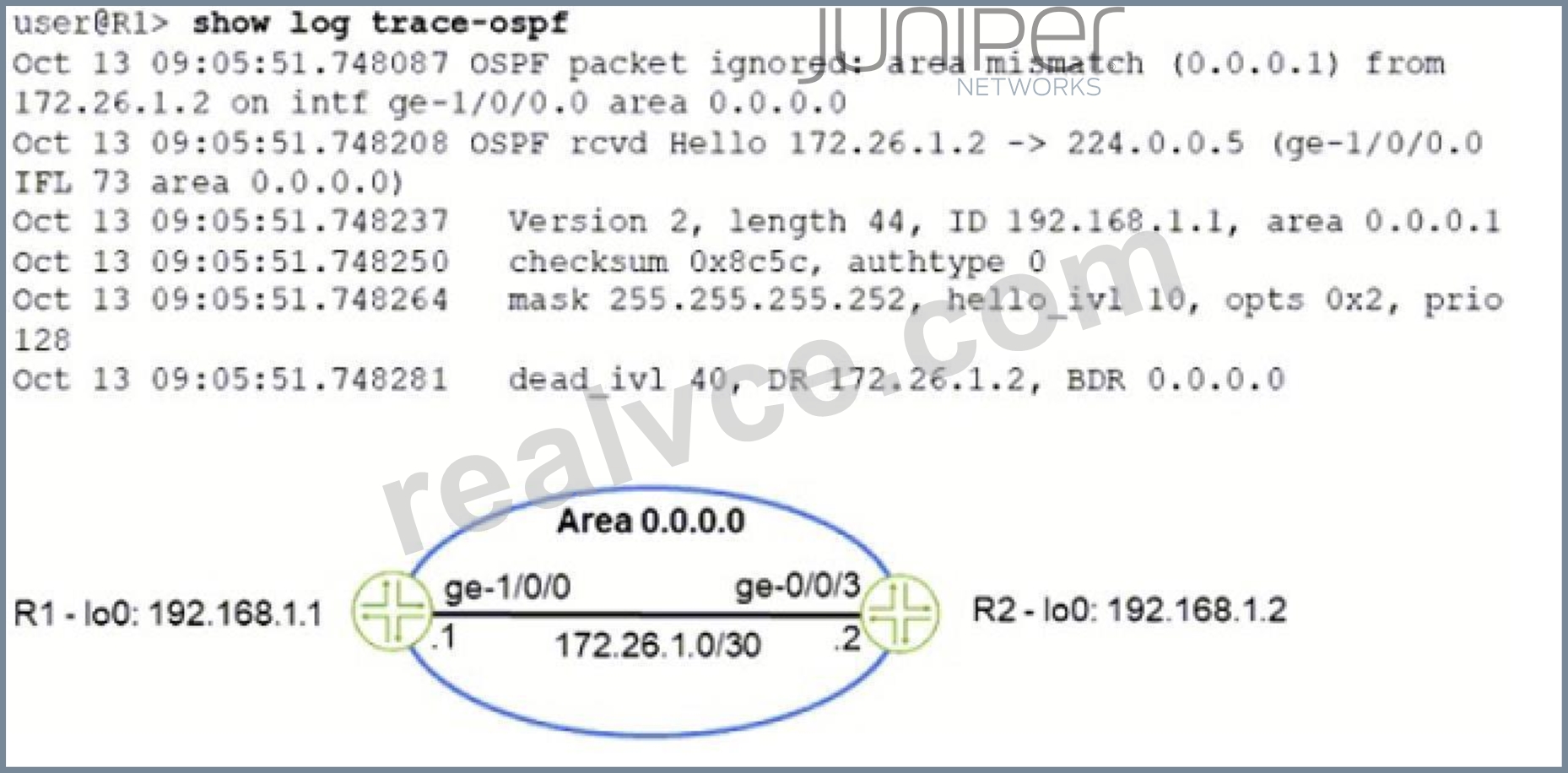
- A. There is a mismatched subnet.
- B. You are stuck in the ExStart state.
- C. The wrong OSPF area has been configured.
- D. The physical connection has been disconnected.
Answer: C
NEW QUESTION # 63
......
Latest 100% Passing Guarantee - Brilliant JN0-351 Exam Questions PDF: https://www.realvce.com/JN0-351_free-dumps.html
Verified JN0-351 dumps and 109 unique questions: https://drive.google.com/open?id=1R4QUAkbE95tAMkYnyLF2I7XBukNLcZb2