


Pass Exam With Full Sureness - Plat-Admn-202 Dumps with 313 Questions
Verified Plat-Admn-202 dumps Q&As - 100% Pass from RealVCE
NEW QUESTION # 33
Ursa Major Solar (UMS) uses a public sharing model for accounts. UMS would like to move to a more restrictive sharing model but wants the Sales team to continue to have access to all account records with the sales record type.
Which two actions should an app builder complete to implement this change?
Choose 2 answers
- A. Update the Sales profile.
- B. Create an owner-based sharing rule.
- C. Create a criteria-based sharing rule.
- D. Update the organization-wide defaults
Answer: C,D
Explanation:
Update the organization-wide defaults and create a criteria based sharing rule are two actions that an app builder should complete to implement the change of moving to a more restrictive sharing model while allowing the Sales team to access all account records with the sales record type. Updating the organization-wide defaults can set the baseline level of access for accounts, and creating a criteria based sharing rule can grant additional access based on record type. Updating the Sales profile and creating an owner-based sharing rule are not necessary or sufficient actions for this change.
NEW QUESTION # 34
An app builder needs to deploy a new account detail page layout from sandbox to production.
Which three components should an app builder include in the Change Set to ensure it deploys successfully and visually as expected?
Choose 3 answers
- A. Custom actions
- B. Lightning App Builder
- C. System administrator profile
- D. Custom fields
- E. Detail page layout
Answer: A,D,E
Explanation:
To deploy a new account detail page layout from sandbox to production, an app builder should include three components in the change set:
Detail page layout: The page layout defines the arrangement of fields, buttons, related lists, and other components on a record detail or edit page. It also controls which fields are required or read-only for users. Source Custom fields: Custom fields are fields that are created by users to store additional information on standard or custom objects. Custom fields can have different data types, such as text, number, date, picklist, etc. Source Custom actions: Custom actions are actions that are created by users to extend the functionality of standard or custom objects. Custom actions can be global or object-specific, and they can invoke different tools such as Lightning components, Visualforce pages, flows, etc. [Source]
NEW QUESTION # 35
Universal Containers has several new fields they've requested for the Opportunity Product object.
What should an app builder be able to configure using a formula field?
- A. A combination of the Opportunity's Text and a Description fields.
- B. A mix of functions and concatenation of 10 Account fields and 10 Opportunity fields.
- C. A hyperlink to the parent Account of the parent Opportunity.
- D. A Rich Text area field that uses HTML to bold certain characters.
Answer: A
Explanation:
Formula fields in Salesforce can use various functions including text, mathematical, and logical functions to create simple or complex expressions. They can handle data from fields of the same record. Option C, "A combination of the Opportunity's Text and a Description fields," is a valid configuration for a formula field as it involves simple concatenation of text fields, which is supported.
Options A, B, and D exceed the capabilities of formula fields:
A: Hyperlinks to other objects using formula fields do not directly support navigation to parent records of a different object.
B: Rich Text and HTML formatting are not supported in formula fields.
NEW QUESTION # 36
Ursa Major Solar (UMS) has a custom object where they track Galactic Vendors. The object has four custom fields for the Galactic Vendors's location: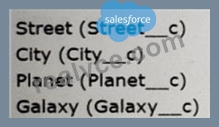
The UMS's leadership wants these fields to be concatenated into a single formula field on two lines.
Which formula fulfills this requirement?
- A.

- B.

- C.

- D.

Answer: C
Explanation:
This formula concatenates the four custom fields for the Galactic Vendor's location into a single text value, separated by commas and spaces. The formula also uses the BR function to insert a line break after the second field, creating two lines of text. Option A, B, and D are not formulas that fulfill the requirement.
NEW QUESTION # 37
Cloud Kicks has three types of customer support processes: Platinum, Diamond, and Bronze. The app builder created separate record types for each process on the Case object. The customer support team should be unable to create new cases with the Bronze record type.
How should this requirement be met?
- A. Update the support team profile to remove the Bronze record type.
- B. Update the organization-wide defaults to private for Case.
- C. Make the record type hidden to support users; update sharing roles to private.
- D. Create permission set group for Case that includes Platinum and Diamond record types.
Answer: A
Explanation:
The solution that should meet this requirement is updating the support team profile to remove the Bronze record type. This way, the support team users will not be able to create new cases with the Bronze record type, as it will not appear in their record type selection list. Option A is incorrect because updating the organization-wide defaults to private for Case does not affect the record type availability, but rather the record access level. Option C is incorrect because creating permission set group for Case that includes Platinum and Diamond record types does not prevent the support team users from creating new cases with the Bronze record type, as they may still have access to it through their profile. Option D is incorrect because making the record type hidden to support users and updating sharing roles to private does not prevent the support team users from creating new cases with the Bronze record type, as they may still have access to it through their profile.
NEW QUESTION # 38
Cloud Kicks wants to make sure that users without the Marketing role are unable to update the Contact Retail Opt In picklist field to Yes.
What validation rule would an app builder use to prevent other users from making this update?
- A. AND( $UserRole.Name = 'Marketing', Retail_Opt_In__c= "Yes" )
- B. AND( $UserRole.Name != 'Marketing', Retail_Opt_In_c = "Yes" )
- C. AND( $UserRole.Name != 'Marketing',ISCHANGED(Retail_Opt_In__c), ISPICKVAL(Retail_0pt_In_c,"Yes") )
- D. AND( $UserRole.Name = 'Marketing', ISPICKVAL(Retail_Opt_In_c,"Yes") )
Answer: C
Explanation:
The validation rule should check if the user role is not Marketing, and if the Retail Opt In field has been changed to Yes. The ISCHANGED function returns true if the field value has been changed, and the ISPICKVAL function returns true if the field value matches a specified picklist value.
NEW QUESTION # 39
Cloud Kicks is redefining its entire business process to convert the Manager Notes field from a long text area field. The goal is to encourage managers to be more concise in their comments and stayat 255 characters or less. There is preexisting information in the Manager Notes field that often is well beyond the character limit.
What would happen to any existing information if the app builder tries to convert a preexisting long text area field to text area?
- A. Preexisting information in the field will be completely lost.
- B. Preexisting information will truncate to the first 255 characters.
- C. Preexisting information will cause a- e-r0- -essace to poo up.
- D. Preexisting information will remain even if it was over 255 characters.
Answer: B
Explanation:
If the app builder tries to convert a preexisting long text area field to text area, preexisting information will truncate to the first 255 characters. This means that any information beyond 255 characters will be lost. Option B is incorrect because preexisting information will not remain if it was over 255 characters. Option C is incorrect because preexisting information will not cause an error message to pop up. Option D is incorrect because preexisting information in the field will not be completely lost, only truncated.
NEW QUESTION # 40
At Ursa Major Solar, there is a single Lightning record page for the Celestial Bodies custom object; however, there is a Lightning component the app builder wants to restrict to mobile app users.
Which feature on the Lightning app builder should be utilized?
- A. Related list quick links
- B. Highlights panel
- C. Chatter feed
- D. Component visibility filter
Answer: D
Explanation:
Component visibility filter is the feature on the Lightning app builder that should be utilized to restrict a Lightning component to mobile app users. According to the Salesforce documentation, "Use component visibility filters to show or hide components on a record page based on field values or user profile." Chatter feed, highlights panel, and related list quick links are not features for controlling component visibility, but standard components that can be added to a record page.
NEW QUESTION # 41
Universal Containers has created two custom objects called Seminars and Attendees. Organization-wide defaults for these objects have been set to Private. Universal Containers wants to set up a new Junction object between these custom objects. A select group of users should be able to edit records in the Junction object.
Which two steps should an app builder take to configure the proper security?
- A. Create owner-based sharing rules that give Read access to the master objects.
- B. Sat lookup filters on both Junction object relationship field.
- C. Set Sharing Settings to Road Only on both Master-Detail relationship fields.
- D. Create an owner-based sharing rule that gives Road action to the junction object.
Answer: C,D
Explanation:
A: Setting Sharing Settings to Read Only on both Master-Detail relationship fields ensures that users can view but not edit the master records from the junction object.
Reference:
Salesforce Help - Sharing Settings
NEW QUESTION # 42
Universal Containers has a custom object that holds over 100 fields. The app builder wants to break up the fields into separate tabs on the lightning page.
Which Lightning component is most appropriate to fulfill this requirement?
- A. Highlights panel
- B. Record detail
- C. Field section
- D. Accordian
Answer: D
Explanation:
The "Accordion" Lightning component is designed to break up content into collapsible sections. This component would be suitable for managing the visibility of large numbers of fields by grouping them into separate tabs or sections that can expand and collapse. This makes navigation easier and declutters the interface.
A: Highlights panel is used for displaying key record information at the top of the page and is not designed for managing multiple fields.
B: Record detail displays all fields on a single layout, which does not suit the requirement to break up the fields.
C: Field section does not exist as a standard Lightning component. Reference: Accordion Component in the Lightning Component Library
NEW QUESTION # 43
An app builder just added a lookup field to Account from the existing custom object, Box.
Which report type is automatically created?
- A. Boxes with Accounts
- B. Accounts with Boxes
- C. Boxes with or without Accounts
- D. Accounts with or without Boxes
Answer: B
Explanation:
Upon adding a lookup field to Account from a custom object, Box:
D . Accounts with Boxes. Salesforce automatically creates a new report type that reflects the relationship from the perspective of the parent object, in this case, Accounts, showing related Box records.
This new report type enables users to create reports that list Accounts along with their associated Boxes, if any.
For further understanding of report types and relationships, Salesforce's guide on Report Types provides comprehensive information on how these are structured following modifications to object relationships.
NEW QUESTION # 44
What are two reason to create an unmanaged package? Choose 2 answers
- A. Distributing upgradeable components to another Salesforce org
- B. Deploying from a Developer Edition environment
- C. Publishing an application for sale on the AppExchange
- D. Distributing open-source projects on the AppExchange.
Answer: B,D
Explanation:
The two reasons to create an unmanaged package are to distribute open-source projects on the AppExchange and to deploy from a Developer Edition environment. An unmanaged package is a collection of components that can be installed in any Salesforce org but cannot be upgraded or controlled by the developer. An unmanaged package can be used to share open-source projects or to deploy components from a Developer Edition environment to another org.
NEW QUESTION # 45
Universal Containers allows all employees to submit reviews for leadership using a custom object called Review. These Reviews should only be visible to the HR department and the employee who submitted the record.
Which three steps should an app builder take to properly control access to Reviews?
Choose 3 answers
- A. Disable Grant Access Using Hierarchies.
- B. Set organization-wide default to Private.
- C. Add a Master-Detail (User; field on the Review object.
- D. Create a criteria-based Sharing Rule for the HR Department.
- E. Remove Review Read permission from non-HR Department user Profiles.
Answer: A,B,D
Explanation:
To control access to the Review custom object such that only the HR department and the submitting employee can see the reviews, the following steps should be taken:
A . Disable Grant Access Using Hierarchies:By default, Salesforce allows users higher in the role hierarchy to access records owned by users lower in the hierarchy. Since reviews should only be visible to HR and the submitting employee, you need to disable Grant Access Using Hierarchies on the Review object to prevent anyone else in the hierarchy from automatically gaining access to these records.
Record Access and Role Hierarchies
C . Create a criteria-based Sharing Rule for the HR Department:With the organization-wide default (OWD) set to Private, you'll need to create a criteria-based sharing rule to ensure that HR users can view the Review records. This rule would give HR access to the records based on a specified condition, such as all records of the Review object.
Reference:
E . Set organization-wide default to Private:Setting the organization-wide default (OWD) for the Review object to Private ensures that no user, other than the record owner (the submitting employee) and those explicitly granted access (HR), can see the Review records by default.
Why the other options are incorrect:
Option B: Add a Master-Detail (User) field on the Review object:This is not necessary in this scenario because the primary relationship is about controlling access through sharing rules, not creating a master-detail relationship. Moreover, this would complicate access control, which is better managed via sharing settings.
Option D: Remove Review Read permission from non-HR Department user Profiles:This step is redundant if the organization-wide default is set to Private. Profile permissions control the general ability to access the object, while the visibility of specific records is controlled by sharing rules and OWD. Removing read access via profiles would block all users, including the ones submitting the reviews, from accessing the object.
In summary, by disabling Grant Access Using Hierarchies, setting OWD to Private, and implementing a criteria-based sharing rule for HR, you can ensure that only HR and the submitting employee can view Review records.
NEW QUESTION # 46
Sales reps want the ability to see who can view their account records and how the people have access.
Which button should the app builder add to the Account page layout to enable this?
- A. Sharing
- B. Fait
- C. Sharing Hierarchy
- D. New Task
Answer: A
Explanation:
The "Sharing" button should be added to the Account page layout to allow sales reps to view the sharing details of an account record. This button enables users to see how access to the record is granted via roles, groups, and manual sharing.
A: Sharing Hierarchy provides a view of the role hierarchy but does not specifically detail record access.
B: New Task is unrelated to sharing visibility.
D: "Fait" is not recognized in Salesforce context as a valid component or feature. Reference: Sharing an Account in Salesforce Help Documentation
NEW QUESTION # 47
UVC's CFO has asked that all deals with more than a 40%discount get automatically sent to the VP of Finance. He will review these deals without the sales rep needing to take action. Which two ways can this be accomplished without building code? Choose two answers
- A. Launch a new approval process that has automatic submission enabled as an initial submission action
- B. Create a new process with a submit for approval action to automatically submit deals for approval
- C. Create a new approval process that has automatic submission enabled in the entry criteria
- D. Launch a flow that uses the submit for approval action to submit deals for approval
Answer: A,C
Explanation:
Launch a new approval process that has automatic submission enabled as an initial submission action, and Create a new approval process that has automatic submission enabled in the entry criteria. These are correct because both options allow the deals to be automatically submitted for approval without requiring any action from the sales rep. The automatic submission can be configured either as an initial submission action or as part of the entry criteria
NEW QUESTION # 48
DreamHouse Realty (DR) has a policy that requires the phone number on Contact to be deleted when the DoNotCall checkbox is checked.
What automation tool should the app builder recommend?
- A. Quick action
- B. Approval process
- C. Validation rule
- D. Workflow rule
Answer: D
Explanation:
The app builder should recommend a workflow rule to automate this process. A workflow rule is a type of automation tool that can execute actions based on certain criteria. In this case, the workflow rule can have a criterion that evaluates if the DoNotCall checkbox is checked on a Contact record, and then execute a field update action that sets the Phone field to null. Option A, B, and C are not automation tools that can perform this task.
NEW QUESTION # 49
Universal Containers wants to deliver purchased containers to remote construction address. In these cases, the customers will supply UC with the coordinates to the location.
What type of field should the app builder use to capture this information?
- A. External Lookup
- B. Number
- C. Geo location
- D. Text
Answer: C
Explanation:
A geolocation field can be used to capture the coordinates of a location in latitude and longitude. This field type can also be used in reports, formulas, validation rules, and Apex
NEW QUESTION # 50
Universal Containers wants to display the real-time stock price for each Account on the Account record page.
How should an app builder implement this request?
- A. Use a scheduled Apex job.
- B. Install a solution from the AppExchange.
- C. Build a Flow that uses API calls.
- D. Create a Lightning Web Component.
Answer: D
Explanation:
The best way to implement this request is to create a Lightning Web Component that can fetch the real-time stock price from an external API and display it on the Account record page. Installing a solution from the AppExchange may not be feasible as it may not match the exact requirements or may have additional costs. Building a Flow that uses API calls may not be efficient as it may consume API limits and may not be able to update the stock price in real-time. Using a scheduled Apex job may not be suitable as it may not be able to run frequently enough to reflect the real-time stock price
NEW QUESTION # 51
An app builder is tasked with adding key performance indicators on client pages. They want to see a summary of the number of open Opportunities and the number of won Opportunities for each Account.
Where should the app builder go to build these new rollups?
- A. Lightning Object Creator
- B. Lightning App Builder
- C. Account Object
- D. Opportunity Object
Answer: C
Explanation:
The app builder should go to the Account object to build these new rollups. A roll-up summary field is a type of field that can aggregate numeric values from child records related to a parent record by a master-detail relationship. The app builder can create two roll-up summary fields on the Account object that count the number of open Opportunities and the number of won Opportunities related to each Account. Lightning App Builder is not a place where the app builder can build these new rollups. Lightning App Builder is a tool that allows the app builder to customize the layout and components of Lightning pages, such as record pages, home pages, or app pages. It cannot create new fields or relationships on objects. Lightning Object Creator is not a place where the app builder can build these new rollups. Lightning Object Creator is a tool that allows the app builder to create custom objects from spreadsheet data by uploading a file and mapping columns to fields. It cannot create roll-up summary fields or relationships on existing objects. Opportunity object is not a place where the app builder can build these new rollups. The Opportunity object is the child object in the relationship with the Account object, and roll-up summary fields can only be created on the parent object.
NEW QUESTION # 52
Universal Containers has a requirement that an opportunity should have a field showing the value of its associated account's billing state. This value should be static after the opportunity has been created.
- A. Formula field
- B. Flow
- C. Apex
- D. Roll-up summary field
Answer: B
Explanation:
The requirement is to copy the parent Account's Billing State onto a custom field on Opportunity at the moment the Opportunity is created, and keep that value static thereafter.
Why not Formula (B): A formula would always recalculate, so the value would change if the Account's Billing State later changes.Exact Extract: "Formula fields are read-only fields that automatically recalculate their values when any referenced fields change." - Salesforce Help | Formula Fields Why not Roll-Up Summary (A): Roll-up summary fields only summarize child records onto a master (parent) record; they do not copy values from a parent (Account) down to a child (Opportunity), and they can't summarize a text/state value.Exact Extract: "A roll-up summary field calculates values from related records, such as those in a related list, on a master record." - Salesforce Help | Roll-Up Summary Fields Why Flow (C) is correct: A Record-Triggered Flow on Opportunity (when a record is created) can set a field value by referencing the related Account (e.g., Opportunity.Account.BillingState) and writing it into a dedicated "snapshot" field (e.g., Billing State at Create__c). Because this is a one-time assignment on create, the value remains static unless intentionally updated by further automation.Exact Extract 1: "Use Flow Builder to automate business processes by collecting data and performing actions in your Salesforce org." - Salesforce Help | Flow BuilderExact Extract 2: "Record-triggered flows launch when a record is created, updated, or deleted, and can update fields on the triggering record." - Salesforce Help | Record-Triggered Flows Why Apex (D) is not preferred: While Apex could do the same copy-on-create, Salesforce's recommended approach is to use declarative automation (Flow) when possible.Exact Extract: "Before considering Apex, evaluate whether your solution can be implemented with declarative tools such as Flow." - Salesforce Architect Guidance | Clicks, Not Code Implementation note (for clarity): Create a custom text field on Opportunity, e.g., Billing State at Create (Billing_State_at_Create__c). Build a Record-Triggered Flow:
Trigger: Opportunity - "A record is created"
Get or use the related Account from the $Record.AccountId relationship
Update the new Opportunity field with Account.BillingState
Do not run the flow on updates
Reference (Salesforce Platform App Builder documents / Study Guide topics):
Salesforce Help - Formula Fields
Salesforce Help - Roll-Up Summary Fields
Salesforce Help - Flow Builder
Salesforce Help - Record-Triggered Flows
Salesforce Architect Guidance - Clicks, Not Code
Salesforce Platform App Builder Exam Guide - Business Logic and Process Automation
NEW QUESTION # 53
Universal Containers' app builder has been tasked with replacing workflow rules and Apex triggers with Process Builders where possible.
What are two important considerations an app builder should know before the project is started?
Choose 2 answers
- A. Avoid generating infinite loops.
- B. Apex has a different SOQL query limit than Flow.
- C. Create a process for each workflow rule.
- D. Combine actions when possible.
Answer: A,D
Explanation:
Before replacing workflow rules and Apex triggers with Process Builders, the app builder should consider avoiding generating infinite loops and combining actions when possible. Infinite loops can occur when a process updates a record that causes another process to run on the same record, and so on. Combining actions can reduce the number of processes and improve performance and maintainability
NEW QUESTION # 54
......
Salesforce Plat-Admn-202 Exam Syllabus Topics:
| Topic | Details |
|---|---|
| Topic 1 |
|
| Topic 2 |
|
| Topic 3 |
|
| Topic 4 |
|
| Topic 5 |
|
Plat-Admn-202 Dumps Full Questions - Exam Study Guide: https://www.realvce.com/Plat-Admn-202_free-dumps.html
Pass Plat-Admn-202 Exam in First Attempt Guaranteed 2026 Dumps: https://drive.google.com/open?id=1X2SXzPcj8ZOhDSNj4HA4Cz_1CrpkmKLq